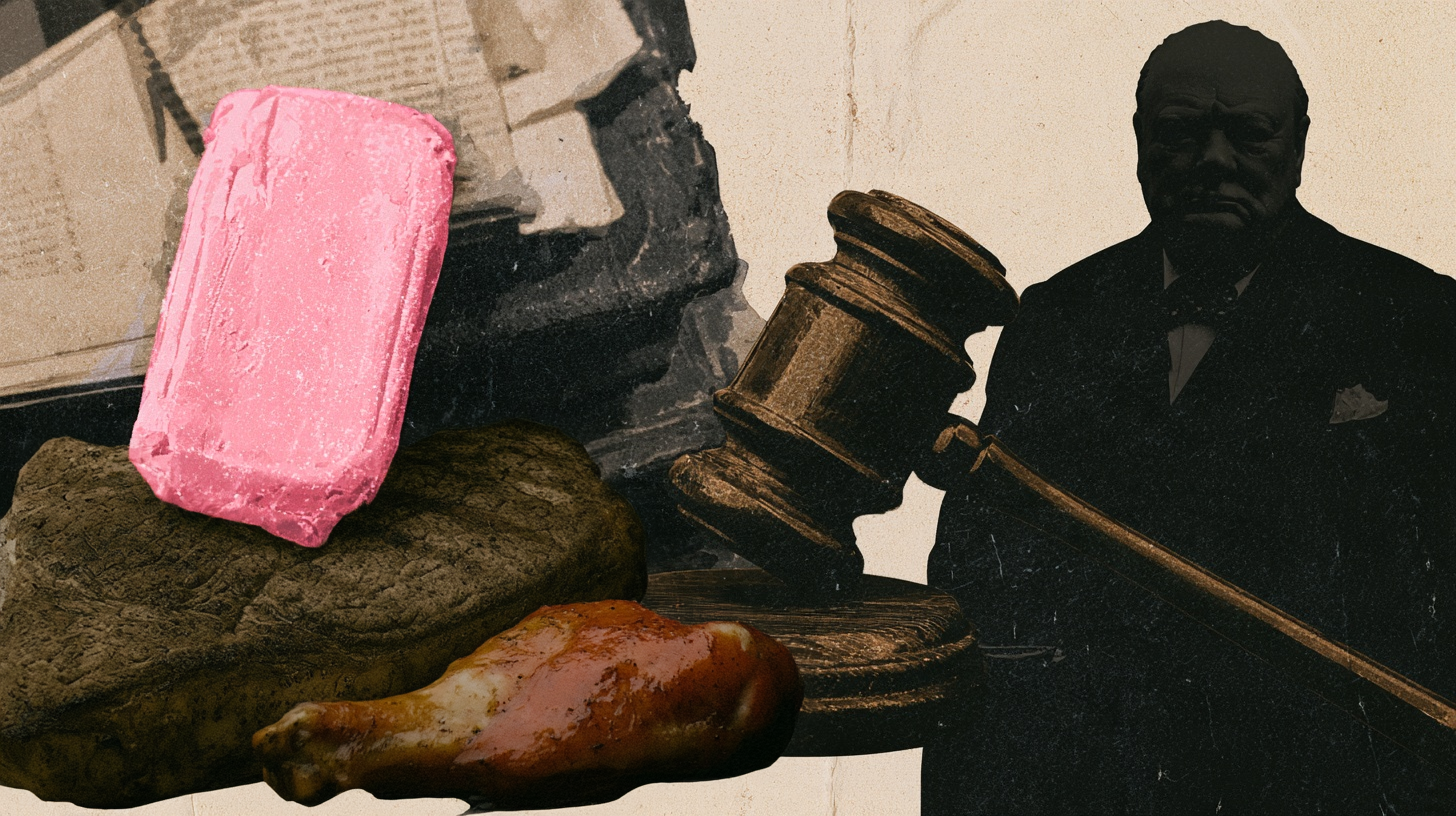
The Color of Real Food

We shall escape the absurdity of growing a whole chicken in order to eat the breast or wing, by growing these parts separately under a suitable medium.
Winston Churchill, “Fifty Years Hence,” The Strand Magazine, December 1931
Hardee County, May 2024
The governor went to cattle country to sign a law against food nobody could buy.
On May 1, 2024, in Hardee County, Florida, he signed Senate Bill 1084, and from July 1 of that year it was a misdemeanor to manufacture, sell, or distribute meat grown from animal cells (Flynn, 2026). The press release preserves his remarks: “Today, Florida is fighting back against the global elite’s plan to force the world to eat meat grown in a petri dish or bugs,” and, to close, “We will save our beef.” Wilton Simpson, the agriculture commissioner, called lab-grown meat “a disgraceful attempt to undermine our proud traditions and prosperity,” and said “We must protect our incredible farmers and the integrity of American agriculture” (Executive Office of the Governor of Florida, 2024).
I have read the release several times looking for the details about food the law prohibits, and it is not in there, because at the time of signing it did not exist as anything a Floridian could buy. No grocer in Florida stocked it. No restaurant served it. Upside Foods, the company that would sue years after the statute’s passing, had cleared the FDA’s pre-market consultation, held a Department of Agriculture grant of inspection, and was selling chicken in California; in Florida it had held one tasting in Miami (Upside Foods, Inc. v. Commissioner, 2026). The FDA’s standing description of the whole industry was that “Manufacturers are generally working on scaling up their processes,” which is regulatory English for not yet (Flynn, 2026). So a state whose public vocabulary is the open market used the criminal law against a food federal inspectors had examined and passed, and did it in a county where the only cultivated flesh for a hundred miles stood on four legs in a pasture.
The mismatch between ceremony and object is where I started, and the vocabulary is what kept me there: petri dish and bugs on one side, tradition and integrity and beef on the other. Neither a petri dish nor a bug is a competitor for prime rib.
Two years later the Eleventh Circuit supplied the line the whole case turns on. On March 23, 2026, a panel held that the Poultry Products Inspection Act does not preempt Florida’s ban, because the federal statute governs a processor’s “ingredients, premises, facilities, or operations,” which is to say how the chicken is made, and Florida’s law “does not instruct Upside how to make its product.” It “bans an end product,” and federal clearance “does not obligate states to permit the manufacture or sale of lab-grown chicken” (Upside Foods, Inc. v. Commissioner, 2026). The federal government owns the process and the state owns the end product, and the case lives in the gap between those two nouns.
Simpson greeted the ruling as a win for “Real Food” and a loss for “Frankenmeat,” adding that the product “is not proven to be safe enough for consumers” (Goñi-Lessan, 2026). The two insults contradict each other: Frankenmeat calls the product meat, monstrous but meat, and Real Food says it is not food at all. Neither word says anything about whether it is safe to eat. Both are about what it may be called, and the safety claim comes last, after the name-calling has done its work.
“Real” is the word to watch. So is the date on the epigraph: the food the law was set against had been described in print ninety-five years before a federal court was asked what it was, by a man who thought it the sane alternative to a chicken.
A Defective Copy
The cultivated-meat bans repeat the historical margarine wars, with two differences. For seven decades the American dairy industry fought a cheaper competitor by persuading legislatures to treat it as a counterfeit. The tactic works for any established industry whose new rival can be made to look like a bad copy of the real thing.
The margarine laws went after a product people were already buying, and the offense was looking like butter. Those laws protected one industry from another and called it protecting shoppers from fraud. The new laws strike earlier, before the product is even on sale, and they object to something more basic than its appearance. The dairy lobby fought over the color of what was in the tub. The cattle and poultry lobbies are fighting over what the meat is made from and whether an animal died for it, and they are fighting a market that does not exist yet.
The margarine story does not explain why a law with nothing to protect bans the product outright, or why several states have written clauses or dates into their bans to trigger them expire.
The Margarine Wars, 1877 to 1950
The wars ran seventy-three years, long enough for a boy born the year New York passed the first statute to buy colored margarine over a counter at seventy-three. By 1877 food was sold across the country, but food law was still local. Butter was a farm product sold in nearby towns, where a cheated buyer knew whom to blame. Margarine came out of factories, moved by rail, and sold under brand names that meant nothing to the woman buying it. The butter came from a county; the margarine came from a company, and the dairy industry faced competition that did not depend on cows, pasture, or weather (Miller, 1989, pp. 83-85).
Geoffrey Miller finds in “the initial battles in the margarine war” some “of the earliest examples of special interest lobbying by one domestic industry for federal protection against competition from another” (Miller, 1989, p. 83). New York passed the first statute in 1877 at the urging of the butter interests; by 1884 it had an outright prohibition and a dairy commissioner with inspectors (Miller, 1989, pp. 112-115). Pennsylvania followed with its own prohibition in 1885, and Congress passed the Oleomargarine Act in 1886, taxing margarine a year before it set up a regulator for the railroads that carried it. Margarine, by Dupré’s account, was the first domestic food the federal government ever regulated (Dupré, 1999).
The prohibitions did not hold. When labeling and prohibition failed, the industry turned to color: a 1902 amendment laid a prohibitive tax on colored margarine, and the federal tax survived until 1950 (Miller, 1989, pp. 83-85). In the 1902 debate, when the tax went to ten cents a pound, Representative William Cowherd of Missouri said out loud who would pay: the bill would, for the laborer with his loaf, “provide that hereafter he must eat that bread unbuttered” (Office of the Historian, U.S. House of Representatives, 2014).
Margarine was the butter of people who could not afford butter. It kept selling through the prohibitions because they wanted it, and when the bans gave way the dairy lobby went after color instead, succeeding, in Miller’s summary, “either by forbidding yellow margarine or by mandating that margarine be colored pink” (Miller, 1989, p. 84). New Hampshire chose pink.
Justice Harlan
The strongest case for the bans was made by one Justice of the Supreme Court across ten years, which is more than most arguments for a food law can say. In 1888 the Court upheld Pennsylvania’s act of 1885, which forbade outright the manufacture and sale of any article made from oleaginous matter to take the place of butter. Justice Harlan wrote that whether margarine was wholesome and whether its sale should be permitted “are questions of fact and of public policy which belong to the legislative department to determine,” and that where a legislature had found a food dangerous “it must be assumed that such is the fact” (Powell v. Pennsylvania, 1888, at 684-685). Six years later he upheld Massachusetts’ narrower law against oleomargarine colored to look like butter, because “the real object of coloring oleomargarine so as to make it look like genuine butter” was that “it may appear to be what it is not,” and because “the Constitution of the United States does not secure to anyone the privilege of defrauding the public” (Plumley v. Massachusetts, 1894, at 467, 479).
Put in today’s terms, a state may decide what counts as food inside its borders, and it does not have to wait for someone to get sick before it is cautious about a new product nobody has eaten for long. The burden can fall on the newcomer, which is what Simpson’s “not proven to be safe enough” asserts and what Powell lets a legislature assert without producing evidence. Meat carries legal, moral, and religious weight, and someone buying meat is entitled to know how it was made. Passing one thing off as another is fraud, and a buyer is owed the truth on the package, which is exactly what one brand of spread prints on its lid: I can’t believe it’s not butter.
On this account the bans are a blunt use of the state’s power to protect health and safety, and I think the belief behind them is sincere. Harlan held it, over Field’s dissent in 1888 and the Chief Justice’s in 1894, and the people in Hardee County hold it. An argument that treats it as a cover story for the cattle business has to explain away the one thing about these laws that is plainly sincere, and it loses there.
Pink
Four years after Plumley the Court struck down New Hampshire’s pink law. Justice Peckham wrote for the majority: “Although, under the wording of this statute, the importer is permitted to sell oleomargarine freely and to any extent, provided he colors it pink, yet the permission to sell, when accompanied by the imposition of a condition which, if complied with, will effectually prevent any sale, amounts in law to a prohibition” (Collins v. New Hampshire, 1898, at 34). Harlan dissented, his third appearance, and I find his consistency admirable. For him pink was a disclosure, a color that told the truth about the tub.
The majority saw the weak point in the fraud argument. If the worry was deception, a label, a placard, or a stamp on the wrapper would have fixed it. Legislatures chose dye, taxes, and bans instead, which took margarine off the shelf and told the shopper standing in front of it nothing. The cheap fix was on the table the whole time and never taken, and the federal tax alone lasted sixty-four years.
The Statutes, 2024 to 2026
Florida’s Senate Bill 1084 makes manufacture, sale, and distribution a misdemeanor. South Dakota’s moratorium runs from July 1, 2026, through June 30, 2031, with jail or a $500 fine behind it; Indiana’s and Texas’s bans expire in 2027 (Haiar, 2026; Flynn, 2026). Louisiana’s Senate Bill 152 prohibits cell-cultured food products, effective only upon “a final ruling by the United States Supreme Court” that such prohibitions do not violate the Constitution (National Agricultural Law Center, 2026b). Arizona and Idaho require labels instead: “cell-cultivated” or “cell-cultured” on the package, and in Idaho the words “steak,” “roast,” and “brisket” reserved for meat from animals (National Agricultural Law Center, 2026a). Louisiana does both, with thirty-point type on the package and a ban that waits for the Court (National Agricultural Law Center, 2026b). Mississippi has added lab-grown milk to its cultured-meat ban, at up to $500 a day (National Agricultural Law Center, 2026a).
Each kind of law has a nineteenth-century ancestor. Powell upheld a ban, and the ban failed because people kept buying margarine. Plumley upheld a rule against margarine dressed up as butter, and that rule held. Collins struck down a condition so hard to meet that it amounted to a ban. Today’s labeling laws follow Plumley, which worked; today’s bans follow Powell, which did not. Each new law is written around the court fight the last one lost. A state that watched a pink law fall writes a ban with no condition to comply with. A state that expects to lose writes a ban that waits for a court. A state that cannot summon the votes for either writes a font.
So some states ban the product, some brand it, and Louisiana’s ban waits to see which of the two a court will allow. They will fail, and they will fail for two reasons that have nothing to do with whether anyone in Tallahassee likes the product.
Wilson, North Carolina
The first is that nobody can yet make the product at a price anyone would pay. Humbird’s techno-economic analysis, built from fermentation and biopharmaceutical practice, found that low growth rates, metabolic inefficiency, and shear damage limit bioreactor volume and cell density, that contamination-safe facilities carry high capital costs, and that growth factors and amino acids are expensive; his conclusion was that the economics “would likely preclude the affordability of their products as food” (Humbird, 2021). The plant in Wilson, North Carolina, is his prediction come true. Believer Meats built it for a reported $150 million and billed it as the only large-scale cultivated meat site in the world, and it went dark in December 2025. In June the North Carolina Business Court approved a $50 million opening bid from Upside, and in August Upside walked, leaving the receiver’s filing to record that “the stalking horse bid no longer exists” (Watson, 2026). Venture money fell from $989 million in 2021 to $36 million in 2025, and the trade press does not expect viability “for at least another decade” (Flynn, 2026).
A ban on something nobody can sell protects no shopper and takes no sales away from any rancher. If the product ever becomes cheap enough to sell, the ban becomes a barrier against meat made in other states, which is the kind of law the Court struck down in New Hampshire under the Commerce Clause. Either way, the law has nothing to stand on.
Sioux Falls and Baton Rouge
The second is the way the laws are written. A prohibition justified by the claim that the product “is not proven to be safe enough for consumers” names no proof, sets no threshold, and designates no office to receive the evidence; no dossier, however thick, could make the product legal in Florida. If the legislature meant what it wrote, the law is about safety in name only, and what it actually protects is the word meat. A moratorium that ends on June 30, 2031, says the product is dangerous until a particular date, which no real hazard is, and what the date buys is five years in which nobody can put the product in a Sioux Falls grocery store and see who buys it. Louisiana’s ban takes effect only if the Supreme Court rules such bans legal, and as far as I can find, no case asking that question is before the Court. Anyone who has run a Dungeons and Dragons table for thirty years will recognize the construction: a contingency spell, cast now, stored in the code with a trigger condition, to resolve whenever the condition is met, by a caster who will not be in the room. No investor builds a plant in a state where the ban is only sleeping.
Thirty-point type is a color, pink by other means. A law that specifies the size of the print on the package regulates the printing because the printing is all the state has left. Under the Eleventh Circuit’s ruling, Washington regulates how the meat is made. A state cannot inspect the factory and cannot block meat shipped in from other states, so it regulates what the product may be called. That is why the labeling laws follow Plumley, and why they are weak: a law about a name gives an inspector nothing to inspect.
The Long View
The honest reply is that none of this matters, because bad laws fall. Joel Mokyr’s account of how Europe turned invention into sustained growth treats resistance to new things as normal for settled societies, since “every invention is an act of rebellion against time-honored beliefs and deeply entrenched customs” (Mokyr, 2016, p. 19). His motto for the cultures that broke through is six words long: “Irreverence is a key to progress” (Mokyr, 2016, p. 17). On that view the bans will go the way of the margarine laws: the margarine taxes were repealed, and Quebec gave up the color of its margarine in the fullness of time.
Polanyi asked the question that answers him: “Why should the ultimate victory of a trend be taken as a proof of the ineffectiveness of the efforts to slow down its progress?” (Polanyi, 1944, p. 36). Margarine won in the end, and the dairy industry still got sixty-four years out of the tax. A law that keeps a product off the shelves for five years has done its job for those five years, whether or not anyone remembers it afterward.
Leviticus
Nothing about the price of the product or the safety of the eater explains a ban that expires on a fixed date. Mary Douglas, writing about pollution rules with dairy nowhere in mind, does. Her reading of the dietary laws turns on a definition: “Those species are unclean which are imperfect members of their class, or whose class itself confounds the general scheme of the world” (Douglas, 1966/2001, p. 56). The cow that dies in a field is meat; meat from a cow that never existed does not fit anywhere. Margarine was a bad fit twice over, an animal fat and then a vegetable fat sold in the color and the tub of a dairy product. Cultivated meat fits worse: animal tissue without an animal, flesh without a herd, a food that requires no death in the one category that, in nearly every cuisine and most religions, is defined by one. “Our pollution behavior,” she writes, “is the reaction which condemns any object or idea likely to confuse or contradict cherished classifications” (Douglas, 1966/2001, p. 37), and “attributing danger is one way of putting a subject above dispute” (Douglas, 1966/2001, p. 41).
The purity is selective. The authors of Senate Bill 1084 do not propose that Floridians stop boiling a kid in its mother’s milk, or that swine remain unclean, or that the prohibition on eating fat be enforced, which would make most American cooking impossible (Leviticus 3:17). The old categories get defended only where defending them pays.
Frankenmeat is Douglas’s reaction in a press release. The prefix has been used against new foods since the fights over engineered crops in the 1990s, and Shelley’s creature is the right ancestor: assembled from parts that should never have touched, and alive without having been born. Both of Simpson’s words are about which category the product belongs in, and the price of chicken barely comes into it.
Habitation
The bans also borrow the language of an older kind of protest. Polanyi’s conflict between “habitation” and “improvement” is the fight between new technology and the people who live where it lands; his claim is that how fast things change, as distinct from which way, is a fair subject for politics (Polanyi, 1944, pp. 34-37). But the protection Polanyi defended was for what he called fictitious commodities, labor and land and money, the things never produced for sale that could not survive being treated as if they were. The cattle lobby is protecting an ordinary market, the market for beef, in the language people use to defend a way of life, and that borrowed language is what lets a fight over price pass as a fight over culture. The butter interest fought the margarine interest as one producer against another, and everyone in the room knew it. The cattle interest fights the “global elite,” an enemy with no address, so that a dispute between two ways of making chicken gets staged as a region defending itself against a caricature.
Consumer protection, followed through, produces a label. Market protection produces a tariff. A total ban on a food people want produces smuggling and, eventually, a retreat to dye, which is the margarine story from Powell to Collins. A criminal ban on a food nobody can yet buy, written to expire in five years or to wake when a court speaks, is the case left over: a purity law with an end date. Price does not predict it, fraud does not predict it, Douglas does.
The costs fall on three groups. The startups pay in money they cannot raise while the map of closed states keeps growing. Eaters pay in a choice they are not allowed to make. And the ranchers pay too, their hardship turned into a talking point for politicians whose law does nothing about the price of feed, the consolidation of the meatpackers, or the drought, and reaches only a product their constituents could not have bought.
Fifty Years Hence
Churchill’s sentence at the head of this piece appeared in the Strand in December 1931, nearly a century ago. His categories are the reverse of ours. For Churchill the whole chicken was the absurdity, the wasteful detour through an animal to get to a piece of meat, and the part grown on its own was the sane and obvious thing. Ninety-five years later the part grown on its own is Frankenmeat and the whole chicken is Real Food, and nothing in the chemistry has changed, only the label. Douglas knew why it would: “Purity is the enemy of change, of ambiguity and compromise” (Douglas, 1966/2001, p. 163).
In Hardee County a governor signed a law against a food his constituents could not have bought, among the animals it would have spared, and called it saving the beef. In 1888 a Court let Pennsylvania ban a food its people were eating, and the ban failed because they kept eating it. In 1898 the same Court looked at a tub of pink margarine and said that a permission no one could use was a prohibition. The present laws skip the permission. They ban the product before it exists, and then hedge the ban: five years in South Dakota, a sleeping trigger in Louisiana, thirty-point type in the states that cannot manage either. The margarine wars, for all their severity, never produced that: a purity rule with a lit fuse, and no one in the room who can say when it will go off.
References
Churchill, W. S. (1931, December). Fifty years hence. The Strand Magazine. Reproduced by America’s National Churchill Museum. https://www.nationalchurchillmuseum.org/fifty-years-hence.html
Collins v. New Hampshire, 171 U.S. 30 (1898). https://supreme.justia.com/cases/federal/us/171/30/
Douglas, M. (2001). Purity and danger: An analysis of the concepts of pollution and taboo. Routledge. (Original work published 1966) https://openlibrary.org/books/OL20041628M
Dupré, R. (1999). “If it’s yellow, it must be butter”: Margarine regulation in North America since 1886. The Journal of Economic History, 59(2), 353-371. https://doi.org/10.1017/S0022050700022865
Executive Office of the Governor of Florida. (2024, May 1). Governor DeSantis signs legislation to keep lab-grown meat out of Florida [Press release]. https://www.flgov.com/eog/news/press/2024/governor-desantis-signs-legislation-keep-lab-grown-meat-out-florida
Flynn, D. (2026, October 11). Sunday edition: Cultivated meat. Food Safety News. https://www.foodsafetynews.com/2026/10/sunday-edition-cultivated-meat/
Goñi-Lessan, A. (2026, March 25). Federal appeals court upholds Florida’s ban on lab-grown meat. WUSF / News Service of Florida. https://www.wusf.org/health-news-florida/2026-03-25/federal-appeals-court-upholds-floridas-ban-on-lab-grown-meat
Haiar, J. (2026, March 11). Governor signs lab-grown meat moratorium, property protections, crypto, national security bills. South Dakota Searchlight. https://southdakotasearchlight.com/2026/03/11/governor-signs-lab-grown-meat-moratorium-property-protections-crypto-national-security-bills/
Humbird, D. (2021). Scale-up economics for cultured meat. Biotechnology and Bioengineering, 118(8), 3239-3250. https://doi.org/10.1002/bit.27848
Miller, G. P. (1989). Public choice at the dawn of the special interest state: The story of butter and margarine. California Law Review, 77(1), 83-131. https://doi.org/10.2307/3480530
Mokyr, J. (2016). A culture of growth: The origins of the modern economy. Princeton University Press. https://doi.org/10.2307/j.ctt1wf4dft
National Agricultural Law Center. (2026a, May 5). Food law in the states – 2026 update. https://nationalaglawcenter.org/food-law-in-the-states-2026-update/
National Agricultural Law Center. (2026b, July 21). Food law in the states: 2026 update part 2. https://nationalaglawcenter.org/food-law-in-the-states-2026-update-part-2/
Office of the Historian, U.S. House of Representatives. (2014, July 29). Tax reform with a side of margarine. Whereas: Stories from the People’s House. https://history.house.gov/Blog/2014/July/7-29-Tax-Reform-with-a-Side-of-Margarine/
Plumley v. Massachusetts, 155 U.S. 461 (1894). https://supreme.justia.com/cases/federal/us/155/461/
Polanyi, K. (1944). The great transformation. Farrar & Rinehart. https://archive.org/details/in.ernet.dli.2015.46560
Powell v. Pennsylvania, 127 U.S. 678 (1888). https://supreme.justia.com/cases/federal/us/127/678/
Upside Foods, Inc. v. Commissioner, Florida Department of Agriculture and Consumer Services, No. 24-13640 (11th Cir. Mar. 23, 2026). https://law.justia.com/cases/federal/appellate-courts/ca11/24-13640/24-13640-2026-03-23.html
Watson, E. (2026, August 24). BREAKING: UPSIDE Foods terminates $50m bid for Believer Meats’ US site but “remains interested in the facility.” AgFunderNews. https://agfundernews.com/breaking-upside-foods-drops-bid-for-believer-meats-us-cultivated-meat-facility
Leave a Reply