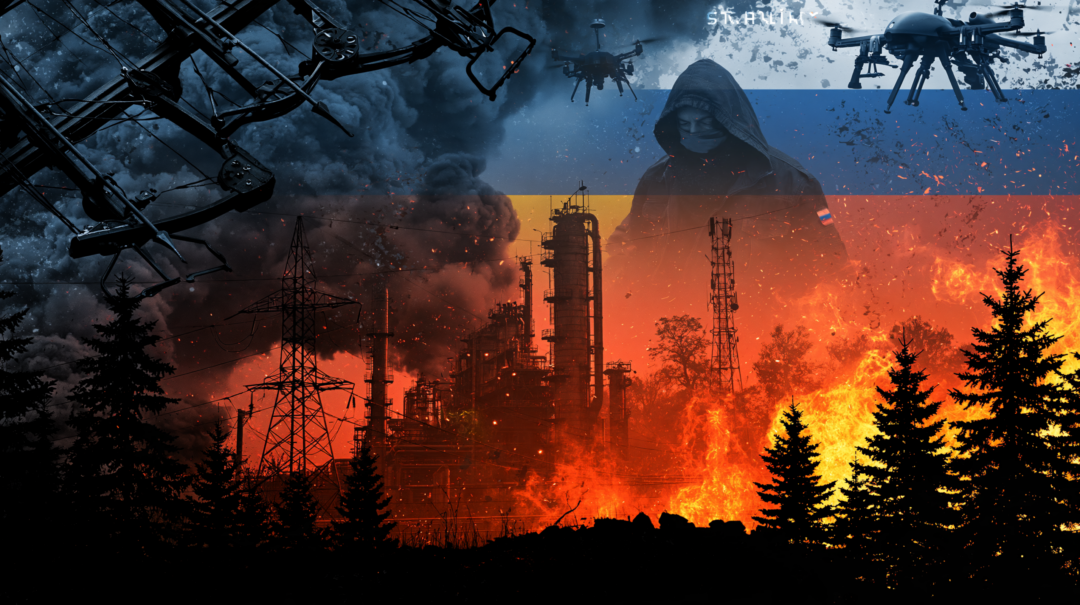
The Crossbow and the Quadcopter

On the first of June, 2025, a small group of unremarkable cargo trucks parked near Russian airbases. One stood in Irkutsk, four thousand kilometers from the nearest Ukrainian soldier. The trucks carried wooden cabins, the kind used for prefabricated housing. Their roofs opened by remote command. When they did, 117 small drones rose out of them and flew the last few kilometers to the aprons where Russia parks its strategic bombers, aircraft designed to carry nuclear weapons across the pole. The drones flew into the bombers. Ukraine’s security service said it had spent eighteen months smuggling the drones and the cabins into Russia. Each drone cost between six hundred and a thousand dollars. The autopilot software was ArduPilot, an open-source project written over nearly two decades by volunteers for hobby aircraft and research vehicles. The drones were flown over Russia’s own mobile telephone networks, through 4G and LTE connections, by operators who were somewhere else (Bondar, 2025). Ukraine claimed more than forty aircraft hit. The bombers, by any count, cost hundreds of millions of dollars apiece. Several were Soviet types no longer in production, which Russia, in the analyst’s phrase, “lacks the industrial base to quickly replenish” (Bondar, 2025).
When I sat down to write about this endeavor, I had expected to write about ingenuity. The raid was ingenious; the Trojan horse rebuilt as freight logistics is the kind of image that organizes a story by itself. What held me was something smaller and older. A machine assembled from consumer parts and civilian code had destroyed, on the ground, the most expensive instruments of twentieth-century deterrence. The actual combat execution came from a distance, the drones operated by someone the bombers’ crews would never see. There was a feeling of technological awe and dread in reading about this that I knew from somewhere. It was the feeling I had reading for the first time about a mounted knight in the twelfth century looking at a crossbow.
In 1139, the Second Lateran Council, meeting under Pope Innocent II, issued thirty canonical writs on the discipline of the Church and the conduct of Christians. The twenty-ninth read: “We prohibit under anathema that murderous art of crossbowmen and archers, which is hateful to God, to be employed against Christians and Catholics from now on” (Second Lateran Council, 1139/1990, p. 203). Historians disagree about what the canon was aimed at, whether the crossbow in particular, archery in general, or the mercenary bands who carried both. They agree it was widely ignored. I am less interested in its enforcement than in its grammar. The canon did not try to ban the weapon, instead it prohibited its use against a class of persons, leaving every other class, the infidel first among them, within the field of fire.
Seven and a half centuries later, Hilaire Belloc used similar grammar in imperial form. In a satirical verse, he put these words into the mouth of a character called Blood, surveying the prospects of a colonial expedition: “Whatever happens we have got / The Maxim Gun, and they have not” (Belloc, 1898). The machine gun was the crossbow’s heir in this one respect: its legitimacy depended on who was on the receiving end. John Ellis, in his social history of the weapon, records that it “became associated with colonial expeditions and the slaughter of natives, and was thus by definition regarded as being totally inappropriate to the conditions of regular European warfare” (Ellis, 1975/1986, p. 57).
The cheap first-person-view drone inverts the Maxim verse’s weight. The Maxim gun concentrated industrial killing in the hands of the power that owned the factory and licensed it against outsiders. The quadcopter disperses precise, distant killing to anyone with a supply chain of consumer electronics, on both sides of the line at once. This restores the crossbow’s original threat: that the cheaply equipped can destroy the expensively made. What the inversion underlines is the hypocrisy in the old canon: the proscription was never about distance, and never about the weapon. It was a rule about who may be killed. The moment the weapon became reciprocal, the rule had nothing left to hold onto.
The differences matter. A Norman knight, a Maxim detachment at Omdurman, and a conscript in a Donbas trench are not members of the same social body, time differences notwithstanding. The drone is cheap in its parts and expensive in its consequences. What is new is twofold: the weapon is now a consumer product running hobbyist code, so the knowledge that kills is absorbed civilian labor carrying no name. And the operator sits inside the same kill zone as his target, so distance no longer purchases safety at the very moment the approach is automated. There is a third novelty. In October of this year, power and money tried to reinforce the hypocritical by asserting ownership of the sky the weapon needs to deploy, rather than the factories that make it.
Stacie Pettyjohn’s report for the Center for a New American Security carries its thesis in its title: Evolution Not Revolution. Most systems remain human-operated. The networking that would let them act as a swarm is thin. Commercial technology diffuses so quickly to both sides that neither gains a lasting edge. Artillery, the oldest killer on the field, remained the dominant one (Pettyjohn, 2024). Field research from the Royal United Services Institute sharpens the point. First-person-view drones “do not function in bad weather, have too small a payload to engage numerous classes of targets, and are comparatively easy to shoot down.” Their operators “can see far more targets than they can hit” (Watling, 2025). On this account, there is no inverted settlement, only a new layer on a very old attritional war of mines, shells, and trenches. The crossbow and the Maxim are ornaments that inflate a tactical change into a civilizational one. The objection lands on the raid itself, a spectacular operation that did not move the front a meter. The production figures, 2.2 million Ukrainian drones in 2024 and a projected 4.5 million in 2025, and the share of Russian casualties attributed to them, which reporting from the front puts at seventy to eighty percent (Nieczypor & Matuszak, 2025), come from interested parties or observers dependent on them. Pettyjohn’s caution is the caution of someone who has watched a dozen revolutions in military affairs fail to arrive. I take it seriously.
The Church in 1139 was attempting to regulate violence within Christendom, in the long campaign that produced the Peace of God, the Truce of God, and the rules of tournament. It singled out a weapon that let a man of no standing kill, from a distance, a mounted and armored noble whose training and equipment represented the accumulated investment of a lineage. The crossbow’s offense was economic before it was moral: it collapsed the ratio between what it cost to kill and what it cost to be killed. The canon’s answer was to make the weapon’s legitimacy depend on the target’s membership in the faith. It protected the investment by drawing a circle around the investors. The Maxim gun is the same logic at industrial scale. The breechloader, the repeater, and then the Maxim gave small European columns the capacity to kill thousands in an afternoon. That capacity was first used in earnest where no one on the other side could answer it. At Omdurman in 1898, after five hours, “20 Britons, 20 of their Egyptian allies and 11,000 Dervishes lay dead” (Headrick, 1981, p. 118), a ratio in the hundreds to one. The moment the Maxim became reciprocal, the colonial massacre turned into European attrition.
Langdon Winner gives the mechanism a name that fits both centuries. A technology’s cost is a political property. The University of California’s tomato harvester, “by their very size and cost, more than $50,000 each to purchase,” was “compatible only with a highly concentrated form of tomato growing” (Winner, 1980, p. 126). The Maxim was compatible only with a state that could build it, which in 1898 meant a handful of states and in practice one empire at a time. Reverse the formula and the FPV drone appears. A weapon that costs five hundred dollars and runs on code anyone may download is compatible with dispersed production at brigade level, with workshops in apartment blocks, with volunteers soldering motors in a garage in Lviv, and with the other side doing the same in Tula. This is where Pettyjohn’s strongest observation turns over in the hand. She is right that commercial technology diffuses to both sides so fast that neither gains a decisive advantage. The Maxim settlement rested on diffusion failing. The drone war is the first industrial war in which the cheap, precise weapon is reciprocal from the first week. No one gains a decisive advantage because the asymmetry on which decisive advantage has rested since 1139 is gone. Flanders is the precedent for the stalemate Pettyjohn describes. Attrition is what a reciprocal weapon produces. It is produced here faster and cheaper than in 1915 because the diffusion that took the Maxim sixteen years took the quadcopter months.
The refinery campaign is the case Pettyjohn’s report could not have seen. It is the crossbow against the knight at the scale of a national industry. Through 2026, Ukraine sent long-range drones, built from the same consumer supply chain as the small ones and costing a tiny fraction of the cruise missiles they replaced, against Russian oil refineries, the most expensive fixed assets in the Russian economy. The International Energy Agency reported in September that a refinery was targeted on average once every three days in the first eight months of the year. Russian refinery throughput fell in June to 3.8 million barrels a day, its lowest level in more than two decades and about thirty percent below the year before (Martin & Vatman, 2026). An attritional war of trenches does not usually reach the other side’s refineries. This one did, because the thing that reached them cost less than the fence around them.
James Scott’s account of the modern state is precise about what legibility presupposes: “Legibility implies a viewer whose place is central and whose vision is synoptic” (Scott, 1998, p. 79). The kill zone is a regime of total legibility with the center removed. In the band the Ukrainian command calls the Drone Line, ten to fifteen kilometers deep by the army’s own description (Nieczypor & Matuszak, 2025), closer to twenty-five by the reckoning of reporters who have driven into it (Beardsley, 2026), anything seen can be struck within minutes. The seeing is done by thousands of operators wearing goggles in cellars, each a small synoptic viewer with a short field of regard and a warhead. Precision was once the luxury of the richest militaries, the Predator’s and the Reaper’s, purchased by the hundred million. It is now available by the hundred thousand. The old link between seeing and ruling has come apart with the price. In Scott’s state, the one who sees can act and the ones seen cannot. In the kill zone, everyone sees, and so no one can move.
Scott also observes that the builders of the modern state “do not merely describe, observe, and map; they strive to shape a people and landscape that will fit their techniques of observation” (Scott, 1998, p. 82). The front has been reshaped to fit the drone’s eye in two ways that belong to different centuries. The first is the fiber-optic drone, which Russia fielded in the summer of 2024 and both sides now use. It is a quadcopter trailing a hair-thin glass filament from a spool, immune to jamming because nothing passes through the air to jam (Nieczypor & Matuszak, 2025). The most advanced weapon on the field defeats electronic warfare by returning to wire, the way the first guided missiles and the field telephone worked. In returning to wire, it returns the operator to a tether that can be followed back to him. The second is the netting. Ukraine plans 2,500 miles of anti-drone nets strung over front-line roads by the end of 2026, so that supply routes run through screened corridors like the covered ways of a seventeenth-century siege (Beardsley, 2026). The landscape is being rebuilt around what the quadcopter can see. This is the most literal fulfillment of Scott’s sentence I know of, performed by two armies at once, neither of which is the state he had in mind.
David Edgerton’s use-centered history of technology insists that the weapons that do most killing are rarely the ones that get written about. “The horse made a greater contribution to Nazi conquest than the V2” (Edgerton, 2006/2008, p. xii), and the shovel, the mine, and the 152-millimeter shell have likely contributed more to the dead of this war than the quadcopter has. His method asks what the alternative was, since “the hidden counterfactual assumption which lies behind the equation of use and significance is that there was no alternative” (Edgerton, 2006/2008, p. 6). The alternative to the FPV drone is the mortar, which works in rain. An essay organized around the drone, on this view, has let the promoters set the agenda. That is the error Edgerton’s whole book is written against.
In another counterpoint, Grégoire Chamayou’s objection is philosophical. In A Theory of the Drone, written in the years of the Predator over Waziristan, Chamayou argues that the drone’s essence is the elimination of reciprocal risk. “For whoever uses such a weapon, it becomes a priori impossible to die as one kills” (Chamayou, 2013/2015, p. 13). Combat becomes a hunt, “a hunter advancing on a prey that flees or hides from him” (Chamayou, 2013/2015, p. 33). And since “the decriminalization of warrior homicide presupposes a structure of reciprocity” (Chamayou, 2013/2015, p. 161), the hunt dissolves the mutual exposure on which the ethics of war, and the warrior’s claim to honor, had rested. On that account, the crossbow is the wrong analogy. The crossbowman stood on the field and could be ridden down. The drone’s novelty, for Chamayou, is that it leaves the field. He knows the Maxim, too. He counts the dead at Omdurman himself and places the drone “in the continuous line of such ‘asymmetrical wars’ involving machine guns marshaled against spears or rusty old guns.” His chapter on the subject ends on a sentence I have not been able to improve: “The drone is the weapon of an amnesiac postcolonial violence” (Chamayou, 2013/2015, pp. 93-95).
Both objections are right about the weapons they describe, and both describe a weapon other than the one in Ukraine. Edgerton’s point stands: the drone works with the shell, spotting for it, finishing what it starts. A history that forgets the shell will be false. But his own method carries the counterargument, because the question “what was the alternative” is the question the Lateran canon was asking. The alternative to the crossbow was the lance, and the lance kept the ratio of cost between killer and killed where the nobility wanted it. The alternative to the FPV drone, in a war where neither side can afford enough shells, was nothing within reach of the men in the trench. The drone’s significance lies in the gap between what the state could supply and what the brigade could build. Chamayou’s objection fails more completely, and more interestingly, because his theory was built on a monopoly, and he says so. The Predator was a Maxim. He placed it in that line himself. Everything he says about the hunt and the loss of reciprocity follows from that asymmetry. The FPV war is the case his model did not anticipate, the case in which both sides hunt and both sides are hunted, and in which the operator sits in a cellar fifteen kilometers from the line with a quadcopter of his own looking for him. Chamayou described the drone as the weapon that abolished risk. In Ukraine, it has restored it.
That is the first of the new things. Inside the kill zone, the operator is hunted by the same class of weapon he flies, often by an operator who found him by following the fiber he trailed. Remoteness, which for Chamayou was a moral shield, has become a shared exposure. Labor is the second. Assembled from consumer quadcopter components, for which Ukraine’s industry remains heavily dependent on foreign suppliers, above all China, which makes about ninety percent of the fiber-optic thread on the market (Nieczypor & Matuszak, 2025), and flown on open-source software written by volunteers for hobby aircraft, the weapon turns uncredited civilian work into the knowledge that kills at the scale of war. The ArduPilot developers did not design an anti-bomber weapon. They designed a flight controller for a Saturday afternoon. It carries no name into the record of what it has done.
Third, the line itself is gone. Faith drew it for the canon, race and the word civilization for the colonial order. The drone war has no status line at all, only the question of who can produce more, faster. The spring of this year showed what that looks like at the edge. From March, Ukrainian long-range drones aimed at Russia began arriving in the Baltic states and other European countries, pushed off course, in the words of Ukraine’s foreign minister, by “Russian electronic warfare deliberately diverting Ukrainian drones from their targets in Russia” (Al Jazeera, 2026a). On the seventh of May, two of them entered Latvia. One came down on a fuel storage facility. Latvia’s defense minister was forced out. Its prime minister, explaining his departure, said the political leadership of the defense sector “has failed to fulfil its promise of safe skies.” Four days later, her coalition broke, and she resigned as well (Al Jazeera, 2026a). A weapon whose path can be bent by the enemy’s electronics cannot honor any line between belligerent and bystander, let alone between faithful and infidel. The anathema needs a congregation. The quadcopter has none.
And then, in October, someone tried to draw the line again. On the ninth of the month, the President of the United States announced a deal under which Russia would supply diesel to American and world markets. His Treasury issued a license permitting the import of Russian diesel, banned by statute since 2022, through the following April. The shortage the deal addressed had been produced, TIME reported, less by Ukraine than by an American war with Iran and the disruption of shipping through the Strait of Hormuz (Schneid, 2026). On the tenth, he said Ukraine should “get a new leader who can make a deal.” On the eleventh, he posted that “Effective immediately, there is an ENERGY CEASEFIRE in the War between Russia and Ukraine,” adding, “Both parties have agreed. Do not break it!” The president of Ukraine said the ceasefire “was news for me” (Schneid, 2026). For several days, Ukraine stopped hitting refineries. Then, in an interview reported on the fifteenth, Zelensky told the Financial Times, “The block is out. We’re done.” That morning, Russia’s defense ministry reported a fire at the refinery in Ryazan, 180 kilometers from Moscow, after drone debris fell onto the site (Orlova, 2026; Al Jazeera, 2026b). The American president called the strikes “a disgrace” that was “making the world oil price higher,” said Ukraine had “plenty of other targets,” and found Zelensky “more difficult to deal with than Putin” (Al Jazeera, 2026b).
This is canon 29 with the categories swapped. The prohibition falls on a class of targets, refineries, where the canon’s fell on a class of persons. The warrant, which in 1139 was the faith of the victim, is the price of diesel in the prohibitor’s own country. “Plenty of other targets” is the canon’s own structure: the murderous art stays licit, the anathema covers only its employment against the protected class. The protected class is whatever costs the prohibitor most when it burns.
What makes October more than an echo is the lever. A crossbow could not be recalled once sold, and the Maxim settlement rested on owning the factory. The FPV drone’s whole premise is that no one owns the factory, since the factory is five hundred workshops and a Chinese parts catalogue. But the long-range campaign runs on something the workshops do not make. Zelensky said that Ukraine had been warned its intelligence sharing would be restricted if the refinery strikes continued. The American president has denied that any sharing stopped (Al Jazeera, 2026b). Limits, Zelensky said, had been placed on Ukraine’s use of Starlink. “It’s a big mistake. This decision will bring a lot of human losses… People will die” (Orlova, 2026). When the restriction came, it bit on terminals moving faster than a hundred miles an hour, a threshold that sorts the sky from the road, imposed overnight and loosened within a day. Elon Musk, whose company operates the constellation, observed that Starshield, the military variant of Starlink that Ukraine’s forces use, is “owned and controlled by the US government” (Osmanqizi, 2026). Here the Maxim reasserts itself one layer up. A power that cannot stop the weapon from being built can still decide, from orbit, which targets it may find. The old monopoly, driven out of the factory, has reappeared in the network. Winner wrote that technological innovations resemble “legislative acts or political foundings that establish a framework for public order that will endure over many generations” (Winner, 1980, p. 128). The drone war is writing two such foundings at once, one in the workshops, which made precise killing common property, and one in orbit, which kept the permission to use it. Who signed the second is in dispute. Reuters was told by three officials that the order to slow the terminals came from inside the White House (Osmanqizi, 2026). The president told reporters “it wasn’t me, and I don’t think it was Elon.” The Telegraph reported that Musk had brought the proposal to him and he had approved it (Dubovyk, 2026). The monopoly in orbit has no admitted hand on it, which pairs it with the nameless code in the workshops. The means of killing carry no author, and now neither does the permission.
A second institution is drawing a line this autumn, somewhere else. In September, the group of experts convened under the Convention on Certain Conventional Weapons closed three years of talks on lethal autonomous weapons. Their report, in Human Rights Watch’s summary, “affirms that human control and judgment are required for compliance with international law.” Seventy-six states now back the opening of treaty negotiations at the Convention’s review conference in November (Coyle, 2026). This is the nearest thing the present has to a council. The parallel with 1139 is exact in form and telling in content. Like the canon, the proposed rule targets a property of the weapon, its autonomy, and leaves untouched the mass-produced, remotely piloted machines that do nearly all the killing in Ukraine. Like the canon, it depends on the consent of the powers that make the weapons. Like the canon, it will be drafted by men who are not standing where the bolts land. Two lines, then, one in Geneva around a quality the drones in the kill zone mostly lack and one in Washington around the price of diesel, and between them, untouched by either, the five-hundred-dollar machine with the hobbyist’s code in it.
Pettyjohn is right that this is an attritional war in which the drone produced no clean revolution. Edgerton is right that the shell and the mine still do most of the killing. Chamayou is right that the drone was born as a weapon of unilateral risk, over Waziristan, in a situation closer to Omdurman than to Donetsk. Each measures the drone by its effect, by its persistence, or by its original doctrine. Each is correct within its measure. None of them touches the thing the Lateran canon and the Maxim gun share, which is a social grammar: legitimacy assigned by who is on the receiving end, and an economy of killing kept stable by making sure the cheap weapon stayed on one side of the line. That grammar explains what the counters leave untouched, which is why the drone war feels morally unmoored in a way the earlier drone debates did not. Those debates assumed the asymmetry and argued about its ethics. The asymmetry has dissolved. Distance-killing was tolerable to its users for as long as it happened to others. In the kill zone, it happens to everyone who flies.
Belloc’s couplet was comic because Blood could say it without fear of contradiction. Rewritten by the present, it loses the joke and keeps the shape: whatever happens, both sides have got the drone. The civilian workbench is the site of the arms race now, and the trucks I began with are the workbench made mobile, a cabin of consumer parts and volunteer code parked outside a bomber base, waiting for someone far away to open the roof. Its decisive text is the hobbyist’s flight controller. The only institutions attempting to draw a line are drawing it around autonomy, which the killing machines lack, or around refineries, which a president’s diesel price requires. In 1139, a council of the Church sought to protect the knight from the crossbow by naming whom the crossbow might lawfully kill. In 2026, a council of states seeks to protect humanity from a machine that chooses, while the machines that do not choose fly in their millions, and a president seeks to protect a fuel price by naming what the drone may lawfully strike. The weapon has become common property. The permission has not. Once the line ran around the murderous art. It now runs around the sky the art needs to see through, and a few still own that.
References
Al Jazeera. (2026a, May 14). Latvian prime minister resigns after drone incident. https://www.aljazeera.com/news/2026/5/14/latvian-prime-minister-resigns-after-drone-incident
Al Jazeera. (2026b, October 15). Trump slams Zelenskyy as Ukraine resumes strikes on Russian oil refineries. https://www.aljazeera.com/news/2026/10/15/russia-says-ukraine-resumes-attacks-on-oil-refineries
Beardsley, E. (2026, March 17). Ukraine strings nets over cities as killer drones turn streets into war zones. NPR. https://www.npr.org/2026/03/17/nx-s1-5743446/russia-ukraine-war-nets-drones
Belloc, H. (1898). The modern traveller. Edward Arnold. https://www.gutenberg.org/ebooks/61521
Bondar, K. (2025, June 2). How Ukraine’s Operation “Spider’s Web” redefines asymmetric warfare. Center for Strategic and International Studies. https://www.csis.org/analysis/how-ukraines-spider-web-operation-redefines-asymmetric-warfare
Chamayou, G. (2015). A theory of the drone (J. Lloyd, Trans.). The New Press. https://openlibrary.org/books/OL27177424M (Original work published 2013)
Coyle, V. (2026, September 7). UN talks on killer robots end with calls for negotiations growing. Human Rights Watch. https://www.hrw.org/news/2026/09/07/un-talks-on-killer-robots-end-with-calls-for-negotiations-growing
Dubovyk, T. (2026, October 17). Trump denies role in slowing Ukraine’s military Starlink. Kyiv Post. https://www.kyivpost.com/post/87351
Edgerton, D. (2008). The shock of the old: Technology and global history since 1900. Profile Books. https://openlibrary.org/books/OL25573148M (Original work published 2006)
Ellis, J. (1986). The social history of the machine gun. Johns Hopkins University Press. https://archive.org/details/socialhistoryoft00elli_0 (Original work published 1975)
Headrick, D. R. (1981). The tools of empire: Technology and European imperialism in the nineteenth century. Oxford University Press. https://archive.org/details/toolsofempiretec0000head
Martin, D., & Vatman, T. (2026, September 17). Russian refining sector struggles amid intensifying Ukrainian attacks [Commentary]. International Energy Agency. https://www.iea.org/commentaries/russian-refining-sector-struggles-amid-intensifying-ukrainian-attacks
Nieczypor, K., & Matuszak, S. (2025, October 14). Game of drones: The production and use of Ukrainian battlefield unmanned aerial vehicles (OSW Commentary). Centre for Eastern Studies. https://www.osw.waw.pl/en/publikacje/osw-commentary/2025-10-14/game-drones-production-and-use-ukrainian-battlefield-unmanned
Orlova, A. (2026, October 15). “We’re done”: Zelensky says Ukraine will resume strikes on Russian oil refineries. Kyiv Post. https://www.kyivpost.com/post/87123
Osmanqizi, S. (2026, October 16). White House ordered restrictions on Ukraine’s Starshield, disrupting drone defense – Reuters. Kyiv Post. https://www.kyivpost.com/post/87219
Pettyjohn, S. (2024). Evolution not revolution: Drone warfare in Russia’s 2022 invasion of Ukraine. Center for a New American Security. https://www.cnas.org/publications/reports/evolution-not-revolution
Schneid, R. (2026, October 11). What to know about Trump’s Russia-Ukraine “energy ceasefire” claim. TIME. https://time.com/article/2026/10/11/trump-claims-russia-and-ukraine-have-agreed-to-an-energy-ceasefire-/
Scott, J. C. (1998). Seeing like a state: How certain schemes to improve the human condition have failed. Yale University Press. https://openlibrary.org/books/OL680025M/Seeing_like_a_state
Second Lateran Council. (1990). Canons. In N. P. Tanner (Ed.), Decrees of the ecumenical councils (Vol. 1, pp. 195-203). Sheed & Ward; Georgetown University Press. https://www.papalencyclicals.net/councils/ecum10.htm (Original work published 1139)
Watling, J. (2025, October 23). Emergent approaches to combined arms manoeuvre in Ukraine. Royal United Services Institute. https://www.rusi.org/explore-our-research/publications/insights-papers/emergent-approaches-combined-arms-manoeuvre-ukraine
Winner, L. (1980). Do artifacts have politics? Daedalus, 109(1), 121-136. https://www.jstor.org/stable/20024652
Leave a Reply