Digital Chirashigaki: Fugu, Inkling, and the Decryption of Reading a Lost Art

Letters That Built Secrets on Many Levels
In the court society of tenth- and eleventh-century Japan, a Heian letter spoke on many levels, in a cipher only the familiar could read whole. Correspondence bore the weight of social life; careers, alliances, and love affairs were conducted on paper, and the medium conveyed almost as much as what was inked on it. Someone who received a letter in that era weighed many components beyond the words it contained: the dye and thickness of the sheet, the season of the sprig or blossom tied to it, the scent worked into the paper or ink, and above all the hand (the method used to generate the characters, and the written inflection of those characters), because calligraphy was read as character, and a person could rise or collapse in another’s estimation on the strength of one glimpsed line in a single character.
The Tale of Genji, our best ethnography of that world, is dense with such appraisals; its people fall for handwriting before they fall for faces, and the next-morning letter after a night’s visit was so fixed a duty that its lateness was itself a message (Murasaki Shikibu, ca. 1021/1925). The script used to render this intimate traffic was kana, the phonetic syllabary the era called onnade, the woman’s hand, brought to its highest pitch by court women largely barred from the Chinese characters of official documents, who made the vernacular letter of old Japan into the most sophisticated encoded communication technology their civilization possessed.
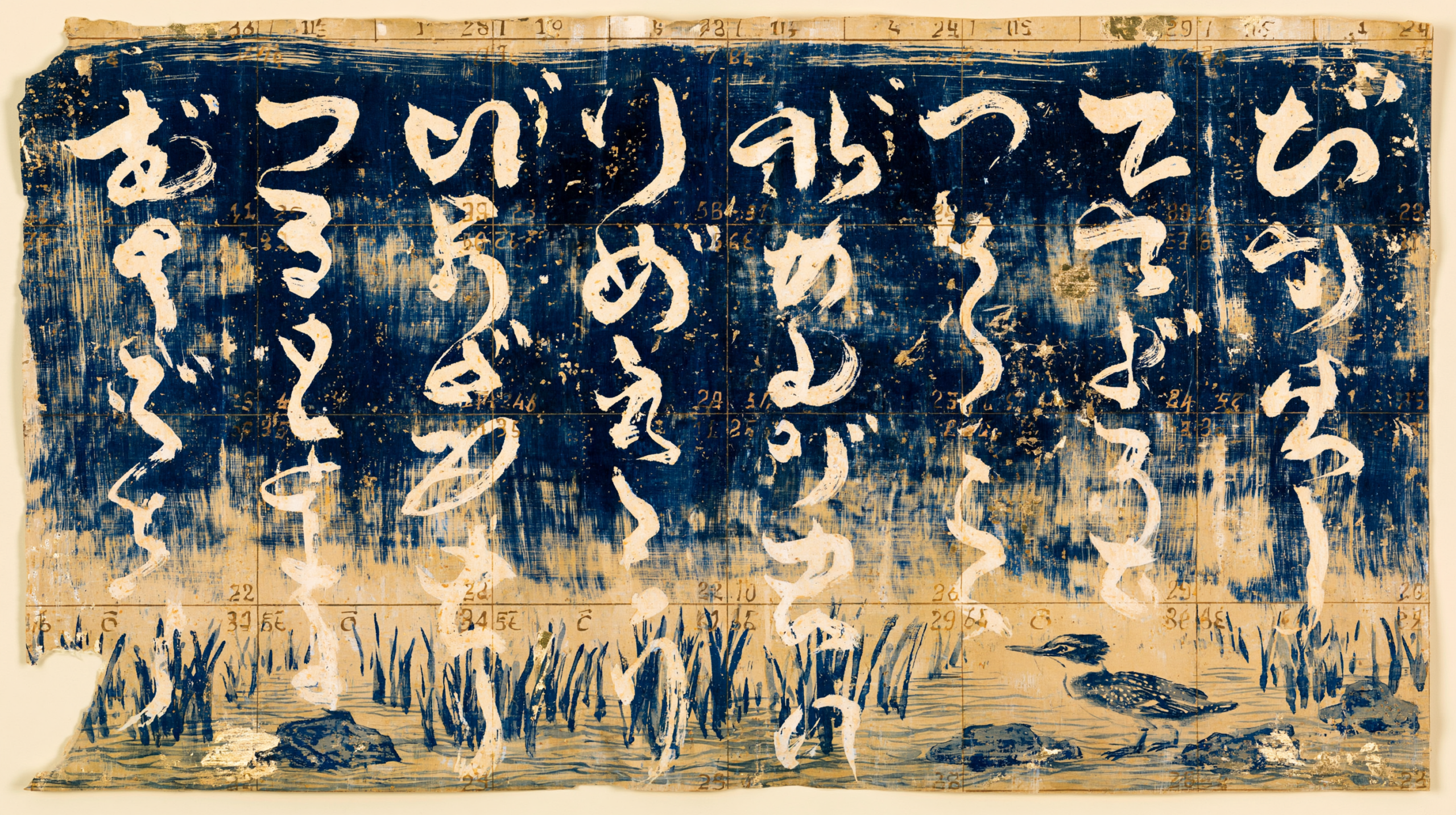
The tradition’s legacy was a way of writing built to be difficult, riddled with hidden messages, and sometimes misdirection. Chirashigaki, scattered writing, staggered its columns at uneven heights, let lines drift and overlap, swelled some characters and starved others, and refused to mark where the eye should enter or leave; the reading order lived in convention, in context, and in acquaintance with the writer’s hand. Beneath the scattering of characters ran a second layer of variance, since classical kana offered a field of alternate glyphs for every syllable, the forms a later standardization would file away as hentaigana, and a cultivated hand chose among them by rhythm and taste, so that even an unscattered line resisted an untrained eye in this flood of phonetic possibility.
At the tradition’s decorative extreme sat ashide, reed writing, in which syllables dissolved into pictures, camouflaged as reeds, rocks, water, and waterfowl along a painted shoreline (Carpenter & McCormick, 2019). As mentioned, this methodology created a rough cryptographic framework. The cipher was social convention rather than encryption algorithm; the keyspace was cultivation, the key exchange was gated by upbringing, and the brute-force attack was a classical education nobody outside the court could afford to buy, or fake. A physical letter in that era passed through many hands before reaching the one meant to open it, and every hand along the way could see the marks perfectly well and take nothing from them; legibility was never the lock. In a world of borrowed messengers and rival households, this method was artistic, durable, and brilliant. Twenty-five such letters, kana-shōsoku, are held today by the Keio Institute of Oriental Classics; one letter from that collection is what ignited this essay in my mind.
None of the letters in that collection were addressed to any of us. In an unprecedented moment ethnographically, orthographically, and technologically, in June of 2026, their reading orders were recovered by machines, and by a stranger mechanism than the title of this essay suggests. Fugu-Ultra, the orchestration model at the center of Sakana AI’s technical report, did not learn to read these letters. It wrote a small computer program, a function over the positions and sizes of detected characters that returns a guessed reading order, and then it convened a committee of not-minds, drawing on Gemini, Claude Opus, and GPT from its worker pool, to mutate and re-score that program through many rounds of beam search until the guessed path of meaning hidden in one of these letters matched an expert scholar’s annotated traversal. Mean normalized edit distance against the expert: 0.776, where the strongest single frontier model driving the same search reached 0.642, and a seed heuristic managed 0.116 (Sakana AI, 2026). Sakana notes, with unusual candor, that no dataset exists for the task and that none can readily exist; even trained readers of classical Japanese find the recovery of one of these letters incredibly demanding.
A letter scattered on purpose, centuries gone, so that only an intimate could cipher it. The path across the page recovered, at scale, by a committee of systems, none of which can be said to have read it, assembled and directed by a fourth system that cannot read it either, and that never, in the operative sense, looked at the page at all. The orchestrator’s contribution was to decide who should look, in what order, with what instructions, and when to stop. The report presents this as a capabilities result, but it is really a parable about where authority now sits in the production of knowledge.
Pantheon on Ice
I should name my personal interest in all this, which is part of why I am knowledgeable about the under-the-hood parts of both LLM mechanisms, and this new breed of routers about to swallow the market. Two winters ago I began building a thing I called Pantheon. It was an inference layer: a classifier trained to differentiate the types of requests arriving at an endpoint, and a router that dispatched each request to one of a set of containerized sub-models, each fine-tuned for a family of tasks, code here, summary there, extraction in the third stall. The name was a joke: a temple where the petitioner does not choose the god; the prayer they make chooses. Half of it works. Half of it sits in a repository the way an engine block sits on a bench in a cold garage, machined, measured, unconnected to a drivetrain, waiting for a block of solid hours of attention that a sixty-hour job, two children, and a perpetual consulting queue have not yet allowed for.
I mention Pantheon not as a claim of precedence, which would be absurd, but as a control variable. The idea of routing requests to specialized models was never unique. It occurred, in roughly the same season, to me, to several thousand other engineers, and to the authors of a dozen papers on mixture-of-agents and learned routing that Sakana’s own related-work section dutifully catalogs. When an idea is that cheap, who had it is the least interesting thing about it. What did the people who realized it at industrial fidelity possess that the rest of us did not? Chase that inquiry down and you end up, of all places, in Paris just after the Revolution.
Sakana Fugu recapitulates, at industrial fidelity and machine speed, the division of mental labor that Gaspard de Prony made operational in the French Bureau du Cadastre in the 1790s, the first system in the West to manufacture the products of thought the way Adam Smith’s pins were manufactured. The Fugu experiment preserves all three of that Parisian system’s inventions: tiered routing of tasks by difficulty, deliberate epistemic partition of the workers, and a written ledger governing who may see whose work. It inverts the one feature of de Prony’s arrangement that every subsequent coordination regime, from the Taylorist planning office to the film studio to the modern engineering organization, never thought to question: the most capable mind in these arrangements sits at the top.
Fugu’s orchestrator is, by design and by measurement, less capable than any of the frontier models it commands, and it outperforms all of them precisely because it never enters the context or work. Inkling, the open-weights model that Thinking Machines Lab released three weeks later with the frank disclaimer that it is not the strongest model available (Thinking Machines Lab, 2026), is a chapter in this same story, though not as a rival. Inkling is the supply of hands on the line. Call the whole arrangement digital chirashigaki: cognition deliberately scattered across many hands, at varied sizes and positions, in no marked order, so that the work is everywhere visible and the path through it is held by exactly one party. The scholars’ letters scattered their characters as an act of trust, because writer and reader shared the key. Every industrial descendant of that gesture has scattered work as an act of control, and the key, the reading order of the scattered whole, has been the asset. The remainder of this essay is the genealogy of that key: the argument that the coordination layer, not the model layer, is where enclosure happens. Two serious bodies of thought say otherwise, and the historical record, read closely, says they are wrong in an instructive way.
The Bureau of the Cadastre
In 1791 the revolutionary government of France resolved to replace the old sexagesimal division of the circle with a decimal one, which meant that every trigonometric and logarithmic table in every surveyor’s and astronomer’s and gunner’s kit in the Republic was about to become wrong. Gaspard Riche de Prony, a civil engineer of real but not first-rank mathematical gifts, was handed the problem of producing new tables at a scale and precision no one had attempted, and he later recorded that the solution came to him from an unexpected shelf: Adam Smith. He would manufacture logarithms, he resolved, the way Smith’s famous workshop manufactured pins (Daston, 1994; Grattan-Guinness, 1990). The first chapter of the Wealth of Nations had described a trade in which one man draws the wire, another straightens it, a third cuts, a fourth points, and the business of making a pin is divided into about eighteen distinct operations, with the result that ten persons make upwards of forty-eight thousand pins in a day where each alone could scarce have made twenty (Smith, 1776). Smith was describing metal. De Prony’s wager was that the same subdivision would work on mathematics.
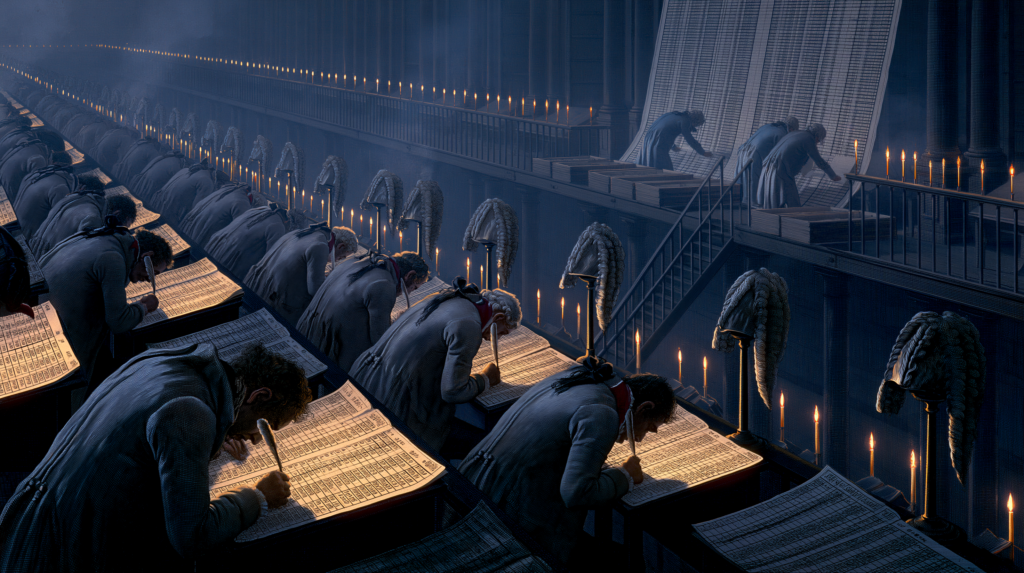
The Bureau he assembled had three sections. At the top sat a handful of eminent analysts, Legendre among them, who selected the formulae and the methods, the differences and the intervals: perhaps a week’s work for the whole project, and the only tier at which anything resembling mathematical invention occurred. Below them, a middle section of seven or eight competent mathematicians translated those formulae into worksheets, sheets ruled and seeded so that every remaining step was pure addition or subtraction, and who verified the returned sheets. The scheme behind those worksheets was the Bureau’s arcane reading order, the knowledge of how eighty scattered streams of addition assembled back into a table, and it lived one tier up from the men producing the streams. The Bureau was a human-powered spreadsheet, each computer an analog cell. At the bottom, sixty to eighty human computers executed those two operations, hour after hour, on numbers whose meaning they were never told. Many of them, by the accounts Grattan-Guinness assembled, were hairdressers, wigmakers thrown out of work when the Revolution abolished the aristocratic coiffure, men whose prior profession had been the ornamentation of heads (Grattan-Guinness, 1990). The output was staggering by any measure the eighteenth century possessed: tables of logarithms and of sines running to seventeen manuscript folio volumes, computed to precisions no instrument of the age could exploit, produced in a handful of years by people who could not, individually, have computed a single logarithm from scratch.
Two features of the Bureau matter more than its throughput or even output. The first item of import is that the ignorance of the bottom tier was not an unfortunate byproduct of the labor market. It was a quality-control mechanism. A computer who understood the scheme might notice a pattern, anticipate a value, introduce an intelligent shortcut, and intelligence, in a system whose correctness depends on independent redundant computation, is a contaminant. Errors were caught by having sheets computed twice by workers who could not see one another’s results, and the comparison of the duplicates did the work that comprehension would otherwise have to do, and did it better. The second feature is what the project did to the meaning of a word. Daston (1994) traces, through de Prony’s tables and their reception, how calculation, which in the age of Gauss and Laplace had been the very signature of genius, drifted over a few decades from the neighborhood of intelligence to the neighborhood of its opposite, until it could be classed as merely mechanical, fit for machines, and eventually assigned to them. What intelligence meant, and still more tellingly who was credited with having it, moved in tandem with the machinery of its production.
Charles Babbage walked through the Bureau’s legacy twice: once as an admirer, devoting the central chapters of On the Economy of Machinery and Manufactures to what he named the division of mental labour and to the economic principle now carrying his name, that a well-divided process lets the master purchase exactly the quantity of skill each subtask requires and not an ounce more (Babbage, 1832); and once as an heir, since the difference engine he spent his fortune failing to complete was, in conception, the Bureau’s bottom two tiers cast in brass. Frederick Winslow Taylor, three generations later, generalized the arrangement from calculation to all work: the managers, he wrote, must take on the burden of gathering up all the traditional knowledge that had lived in the heads of the workmen, reducing it to rules and formulae, and relocating it to a planning department, leaving the shop floor with execution alone (Taylor, 1911). Conception on one side of a wall, execution on the other. Braverman (1974) would name that wall as the constitutive act of the twentieth-century labor process, the separation that turns craft into task, and though his critics have rightly noted that he lit the pre-industrial craftsman a little too warmly, the wall itself has never been credibly disputed in practice or academia. What has never happened, in two hundred and thirty years of the wall’s history, is a case in which the conception side of it was staffed by the less capable party. Legendre sat at the top. The hairdressers were cheap.
Objections and a Point of Order
Before this sprawling analogy is allowed to play out, it should address two major points of dissension, neither trivial, and one of them uses Sakana’s own numbers.
The first belongs to Fred Brooks, and it is now fifty years old and undefeated in home territory. The Mythical Man-Month‘s central claim is that workers and the time to produce outcomes are not interchangeable, because a task divided among n workers acquires a coordination burden that grows roughly as n(n-1)/2, the count of channels along which the workers must keep one another honest, and past a modest n the burden eats the potential of expedited outcomes (Brooks, 1995). Adding manpower to a late software project makes it later. Take Brooks at full strength and an architecture premised on multiplying workers per task should choke on its own communication overhead, and an honest reader of Sakana’s headline table finds Brooks waiting there in ambush. Fugu-Ultra, the deep-orchestration variant that composes multi-agent workflows for the hardest problems, loses to plain Fugu, the variant that simply picks one worker and gets out of the way, on SciCode, on the τ³ Banking dialog benchmark, and on Long Context Reasoning, and it loses to a bare GPT-5.5 on the MRCRv2 retrieval test (Sakana AI, 2026). Those are Sakana’s numbers, not a critic’s, published in Sakana’s own model card. More coordination is not monotonically better, and the vendor’s data says so.
The second objection comes from Narayanan and Kapoor, and it targets the evidentiary stage. Benchmarking, they argue, is simultaneously the practice that made rapid AI progress possible and the mechanism by which researchers most reliably fool themselves, since it is extremely easy to evaluate a model on data that flatters it, and a leaderboard victory is a claim about a leaderboard, which may or may not survive contact with real-world work applied to the model (Narayanan & Kapoor, 2024). Fugu’s comparison table carries a footnote that should be read twice: the baseline scores are provider-reported wherever available, while Fugu’s own scores were produced by Sakana, under Sakana’s harness configurations. The report’s most arresting claim is that learned orchestration of publicly available models reaches and exceeds the performance of Anthropic’s then export-controlled Fable and Mythos class, models that were not in Fugu’s pool because, through that window, no one outside a small list of approved organizations could call them. This is a claim assembled from two different measurement schemas and aimed squarely at a geopolitical anxiety. Frontier capability without the risk of export controls is a sales pitch to techbro lucre, wearing a benchmark as a lab coat. The skepticism is earned, and I will not pretend otherwise, having spent a professional life explaining to well-intentioned education professionals that the vendor generated chart or case study is not truly indicative of the vendor’s product.
Both objections aim at the modules: Brooks at the cost of coordinating them, Narayanan and Kapoor at the claims made for their combined output. Neither addresses the wall, nor the layer doing the coordinating.
The Stopwatch and the Access List
Brooks’s law is a law about a particular medium of coordination: human conversation, with its meetings, its documents, its onboarding, its irreducible latency of mutual understanding. Fugu’s coordination is not conducted in that medium. The fast variant does not even generate text to make its routing decision. A lightweight selection head reads a hidden state inside the orchestrator’s forward pass and emits a distribution over workers before autoregressive decoding begins, so that the entire act of deciding who should do the work costs about as much as beginning to type the first word of an answer (Sakana AI, 2026). Brooks’s n(n-1)/2 channels still exist, but the price per channel has fallen by perhaps nine orders of magnitude, and a law about overhead is only as binding as the cost of that overhead. Where the overhead does survive, in the Fugu-Ultra workflows that run through generated conversation, Sakana’s own losing benchmarks show Brooks collecting his tax exactly as predicted, on tasks where the work is retrieval or sustained single-context dialog and a committee has nothing to add. The law is not refuted. It is repriced, and the price now varies by up to six commas depending on the work being fed into the stream.
The benchmark objection is harder, and the answer to it is the chirashigaki experiment, which is the kind of evidence Narayanan and Kapoor’s critique demands: an off-leaderboard task, constructed and hand-annotated by a domain expert, on which no training data exists or can exist, evaluated by an edit-distance metric with no room for harness gamesmanship. That the orchestrated system’s margin was largest there, on the task furthest from the contaminated commons of public benchmarks, is the single strongest fact in the report, and it is a fact about generalization, not about a leaderboard.
But the deeper reply to both objections is that they mistake what Sakana actually built, and the report, read as an anthropologist reads research rather than as an engineer reads a spec, confesses the true asset of the experiment in its training section. To produce the supervision signal for the fast router, Sakana ran every worker model in the pool on every task in a vast collection of verifiable problems, n repetitions each, scored every attempt against grounded truth, and converted the measured performance into a soft distribution over workers, per task, per domain (Sakana AI, 2026). Strip the machine-learning vocabulary and what remains is a time-and-motion study of the entire frontier model industry: Taylor’s stopwatch, swung not at a man shoveling pig iron but at every commercially available machine intelligence, continuously, with the report noting that the coordinators are retrained as new models ship. The stopwatch never stops. Pantheon does not languish in my virtual garage for lack of an idea. It sits for lack of time to develop a stopwatch and the compute to swing it, and that distinction, between the idea of routing and the industrialized measurement that makes routing trainable, is the distinction between a sketch of the Bureau and the Bureau.
De Prony’s other two inventions are present in the report under new names, so closely that it reads less like influence and more like convergent rediscovery. The Bureau forbade its computers knowledge of the formulae it was developing because a clever computer corrupts redundant verification. Sakana enforces what it calls intra-workflow agent isolation, and names the failure mode it prevents orchestration collapse: if the agents can see one another’s working trajectories, the first agent to touch the environment fixes the frame of calculation for every agent after it, and their contributions collapse into redundancy (Sakana AI, 2026). The workers must be partitioned from one another’s reasoning or the ensemble is worth no more than its first member. That is de Prony’s rule against cleverness, restated as a finding about language models, arrived at empirically, two hundred and thirty years after it was engineered. Where the Bureau’s middle section governed the flow of worksheets, the Conductor framework inside Fugu-Ultra emits, for every query, a structured workflow: a natural-language subtask, an integer identifying the assigned worker, and an access list, an explicit index of which prior outputs that worker is permitted to see. An access list, read plainly, is a permissions regime over knowledge, a ledger of who may know what, written fresh for each question, and the Bureau would have recognized that in an instant.
The access list, in a different context, is a reading order: the path across a page of deliberately scattered work, composed per query, and shown to no one.
Three Expositions Over Time
The pattern I have been describing, subdivision plus partition plus routing yielding a discontinuous leap in output, is not a one-off of revolutionary Paris. It recurs many times through history, but here are three I feel align best with the underlying premise all of this is trying to pry up.
Begin in a converted apartment building at Los Alamos in 1944, where the theoretical division’s computing group had a room of IBM punched-card machines, tabulators and multipliers and collators, each performing one arithmetic operation on a deck of cards before passing the deck to the next machine. Richard Feynman, who ran the group, describes in his Santa Barbara reminiscence how the implosion calculations were organized: a problem became a cycle of cards moving through the machine sequence, and the group’s decisive innovation was to run several problems through the room at once, staggered, each in a different color of card, so that while one deck was being multiplied another was being tabulated, and the room’s stages were never idle (Feynman, 1975). Each color was a reading order discernible to anyone with eyes, the path of one problem clearly visible through the scattered stages of the room. This team invented pipelining before the word, in cardboard, and the throughput gain was not from adding machines but from raising the occupancy of the machines they had, which is Fugu-Ultra’s tree-structured workflow with access lists, executed at walking pace by young men carrying decks.
The Los Alamos story contains a second act, which runs counter to the preceding examples, and is strikingly human. The technicians running those machines, Feynman recounts, had been recruited without clearance to know what the numbers were for, in perfect de Prony fashion, and the work crawled: cards mispunched, cycles wasted in simple errors, no urgency and no invention. Feynman went to Oppenheimer and got permission to tell the team what they were working on. The transformation, he says, was complete. The men began working nights, inventing improvements to the process, discovering better ways to schedule the decks; problems that had taken months took weeks, because the workers now knew what a problem was and could see the war inside the arithmetic (Feynman, 1975).
Here is the Bureau’s rule inverted by human material. For human computers, knowledge of the whole can be fuel, and the partition that guarantees verification in de Prony’s scheme is purchased, in productivity, at the price of everything that makes humans better than tabulators. Taylorism’s whole moral history, the deadening that Braverman (1974) indicts, lives in that trade. Feynman’s men worked worse when partitioned from meaning. Sakana’s models work worse when exposed to one another’s context; shared trajectory is what collapses them. The isolation that demoralizes a human worker costs a stateless model nothing, and the disclosure that transformed Feynman’s room would, applied to Fugu’s pool, destroy the ensemble’s value.
Whatever else the new division of mental labor is, it is the first one whose workers are improved by the ignorance that ruined all the previous workers, and a coordination regime freed from the morale constraint is freed from the constraint that made every earlier regime negotiate, however brutally, with its labor.
In 1712 a French Jesuit named François Xavier d’Entrecolles, stationed among converts in the porcelain city of Jingdezhen, sent his superiors a long letter, the first detailed Western account of how Chinese porcelain was made, and it is, among other things, the first great ethnography of parallel manufacture (d’Entrecolles, 1712/1906). What astonished the Jesuit was not a secret ingredient but an organization: the work so subdivided that a single cup passed through dozens of specialized hands, one man forming, another trimming the foot, others laying on the rings of color, a painter of mountains who painted only mountains and a painter of birds who painted only birds, kilns firing day and night until the whole city seemed one furnace with many vent-holes. The throughput fed an export flood that Europe experienced as a kind of material impossibility, millions of pieces of a substance the West could not make at any price, and the arrangement, through careful documentation, migrated.
Josiah Wedgwood copied d’Entrecolles’s description of the divided workshop into his commonplace book and later built his Staffordshire works on its plan. The feature this case contributes is the fate of the whole. In Jingdezhen no single worker held the complete art, and so no single defector could carry it away; the arcanum Europe hunted was partly a chemistry but largely an organization, and an organization could not be smuggled out of a workshop in a pocket. The configuration of a workshop in this manner was a page of scattered characters that no worker in it could read whole; the reading order was the organization itself, and it could not effectively be recreated by any one defector. The subdivision that disciplines labor in this manner also, and not incidentally, encloses the craft.
Similarly, the workshop of Peter Paul Rubens in seventeenth-century Antwerp produced on the order of fourteen hundred paintings, a number no single pair of hands could approach, and it did so by routing: Frans Snyders took the animals, Jan Wildens the landscapes, pupils blocked in the figures from the master’s oil sketches, and Rubens supplied the conception, the corrections, and, on the works that mattered, the final unifying pass of his own brush. What makes Rubens indispensable here rather than merely illustrative is a document. In 1618, negotiating a trade with the English collector Sir Dudley Carleton, Rubens sent a priced inventory of available pictures in which each work is graded by the degree of his own hand: this one entirely by me, this one begun by a pupil and wholly retouched by me, this one by a pupil after my design (Magurn, 1955). The Carleton list is a reading order written down, the master’s own record of how conception and execution were scattered across the shop and reassembled under one name, kept because the market priced the path. The coda of this particular anecdote is instructive: where such ledgers were not kept, or did not survive, art history inherited a permanent forensic crisis, whole scholarly careers and institutional projects spent prying workshop pictures apart from autograph ones. Connoisseurship as the archaeology of a lost access list. Provenance, it turns out, is the thing the price system runs on, and when the division of labor discards it, someone downstream pays decades to reconstruct it, if reconstruction is possible at all.
Each of these cases brings a specific facet of clarity to the process of routing. In Los Alamos, that the partition rule is a fact about the worker’s motivation, and changing the motivation changed the outcomes. In Jingdezhen, that a similar subdivision enclosed the craft against workers and rivals alike. In Antwerp, that the reading order written down is an asset, and unwritten is a wound that oozes across collections to this day.
The Modularity Wager
Baldwin and Clark (2000), studying how IBM’s System/360 remade the computer industry, argue that modularity’s first product is option value, not labor discipline. Split a system into modules behind stable interfaces and you multiply the number of independent experiments the world can run against each module; every module becomes a slot into which any outsider can offer a better part, and the value of the whole system comes to include a portfolio of options on everyone else’s ingenuity. The System/360’s modular architecture did not merely reorganize IBM’s workforce. It detonated the industry into hundreds of plug-compatible firms, dispersing power away from the very company that designed the architecture. On this reading, Fugu is a liberation machine: it converts the frontier model market into slots, and Inkling is the first product of that proof of concept. Thinking Machines shipped a near-trillion-parameter mixture-of-experts model, forty-one billion parameters active per token, under an Apache 2.0 license, weights downloadable from a public repository, explicitly positioned not as the strongest model but as the most adaptable one, a foundation any enterprise can fine-tune on its own judgment through the company’s Tinker platform (Thinking Machines Lab, 2026). A world of open, specializable workers slotting into learned orchestrators is, in Baldwin and Clark’s terms, a world of exploding option value, distributed to whoever can fine-tune.
There is a prophetic tradition behind that hope, which is where the automobile industry finally enters this essay, not at all in the location I thought it would be when I first started outlining this essay. Piore and Sabel (1984), writing at the moment when flexible, computerized, small-batch manufacturing was overtaking the classical Fordist line, argued that the second industrial divide could reverse the first: flexible specialization would return production to networks of small, skilled, craft-like firms, reviving the yeoman industrial districts that mass production had crushed. It was the most humane prediction the decade produced. It is also forty years old, and the districts did not, in the main, arrive. What arrived, in the industry Piore and Sabel watched most closely, was tiered subcontracting, supplier squeeze, and a distribution of power that concentrated at the coordinating apex more tightly than Fordism ever managed, because the apex of the manufacturing process no longer needed to own the factories it disciplined. The prophecy’s grammar has not aged a day. Sakana’s own framing of Fugu, orchestration as a hedge against single-vendor dependence and export control, capability distributed more broadly across organizations and regions rather than concentrated in whoever trains the largest model (Sakana AI, 2026), is Piore and Sabel’s sentence with the nouns swapped, issued at the same point in a far more rapidly evolving cycle, by the party building the apex.
The Enclosure of the Reading Order
When the modules are abundant, what remains scarce?
Baldwin and Clark are right that open modules multiply experiments, and every experiment Inkling’s openness enables produces a new specialized worker whose measured profile flows into one place. The option value is real. It is being harvested at the routing layer, which holds options on the entire pool while owning none of it, and each new open worker widens the orchestrator’s edge while cheapening the hands. Brooks is right that coordination is a tax, and Sakana’s own losing benchmarks show the tax being paid. Both objections are true, and both are about the modules, and the Bureau already taught us that the modules were never the asset. Legendre was the asset in 1794, and Legendre is now abundant too, sitting in the pool at so much per million tokens; the scarcity has moved up one story, from the best mind to the reading order of minds, and the record holds no case of it ever moving back down.
Which brings us to the inversion, the thing that is without precedent in the two-hundred-and-thirty-year record, and Sakana’s own trajectory analysis states it more plainly than any critic could. In one software-engineering task the report walks through, Opus, assigned to fix a failing validation, tracked the fault down through server registration into the depths of a one-time-password library and reached a dead end, captured, as any strong engineer can be, by the first plausible frame. The orchestrator’s response was not to think harder about the bug, which it could not have done; it was to summon GPT with a clean slate, and GPT, unburdened by the trail, saw at once that the fault was never server-side at all but a client concurrency error for which the server’s complaint was a mere symptom (Sakana AI, 2026).
The router outperformed Opus on that task while knowing incomparably less than Opus about the code, about the library, about everything, because the one property the router is built around is that it never enters the file, and so it never inherits the first framing of anyone who did. The router’s intentional ignorance is not a limitation being managed. It is the fulcrum of the extraordinary work it achieves.
Orchestration collapse, Sakana’s own phrase, names the contamination of the coordinating layer by a worker’s trajectory; the entire architecture is an apparatus for keeping the top of the hierarchy uninformed. Every prior regime put the most knowing party in the chair: Legendre chose the formulae, Rubens painted the final pass, Taylor’s planning office justified its existence by knowing the job better than the man who did it, and even Brooks’s surgical team put the one irreplaceable expert at the center.
Fugu is the first coordination regime whose commanding layer is deliberately, permanently, and profitably the least informed party in the room, and there is no precedent for it. Yampolskiy (2024) argues that advanced AI systems are unexplainable in a strict sense, their decisions unauditable even by their makers; a routed answer compounds the problem, an unexplainable verdict about which unexplainable system to trust, synthesized from workers the report itself anonymizes, in its qualitative comparisons, as Model A, Model B, and Model C. Rubens sent Carleton the ledger. This new digital workshop, in its own technical report, redacts before the paintings have even started to dry.
Reading Back the Hidden
Brooks correctly prices coordination in the medium of human speech, and wherever Fugu’s workflows re-enter that medium’s conditions, long shared context, sustained dialog, his tax reappears in Sakana’s own tables. Narayanan and Kapoor correctly refuse the leaderboard as proof, and the argument’s confidence rests not on Table 1 but on the off-benchmark chirashigaki result they would demand. Baldwin and Clark correctly describe the option value that open modules create, and Inkling will create it. All the historical cases, run from the Bureau through Antwerp to the punched-card room, show with some consistency that in a divided system the modules are never where the durable power settles.
Power settles in the tier that measures, routes, and remembers, and the predictions that follow from that claim are the ones the present case keeps confirming:
- that the orchestrating firm would publish its methods and withhold its measurements;
- that it would retrain the coordinators on every model release;
- that it would name its workers where attribution flatters, in the benchmark table, and anonymize them where it does not, in the case studies;
- that it would sell access to the judgment rather than to any mind, pricing the interface and renting the pool; and
- that open weights would strengthen rather than threaten it.
What this protracted octopus of comparison finally surfaces is a claim about literacy, which is a large part of what motivates me to write. The Bureau’s lesson, in Daston’s telling, was that a capacity, once divided and routed, drifts out of the category of intelligence entirely; within a lifetime, calculation went from the mark of genius to the definition of the mindless. The capacity now entering the Bureau is not arithmetic. It is the sequence of acts I would once have called studying a problem: framing it, choosing who or what to consult, weighing the returns, synthesizing a judgment.
The pitch of the orchestrated future is that you need not hold the whole; you need only know who to ask, and the system will even figure that out for you, given sufficient application of time or money. I have spent years arguing against the pedagogical version of that bargain, the one that calls a child literate enough when they can survive a form and a menu, on the grounds that deep inquiry is gated by deep literacy and nothing downstream can compensate for a lack of skill or ability to bypass the gate.
The routing table is that bargain, poured into infrastructure. It will be efficient. The Bureau was efficient. The question a civilization should ask before wiring its cognition into a hierarchy built to keep its own top ignorant is what happened to the last several capacities it routed this way, and the record’s answer is that they became, first invisibly and then officially, things no educated person valued or extolled in an enlightened society.
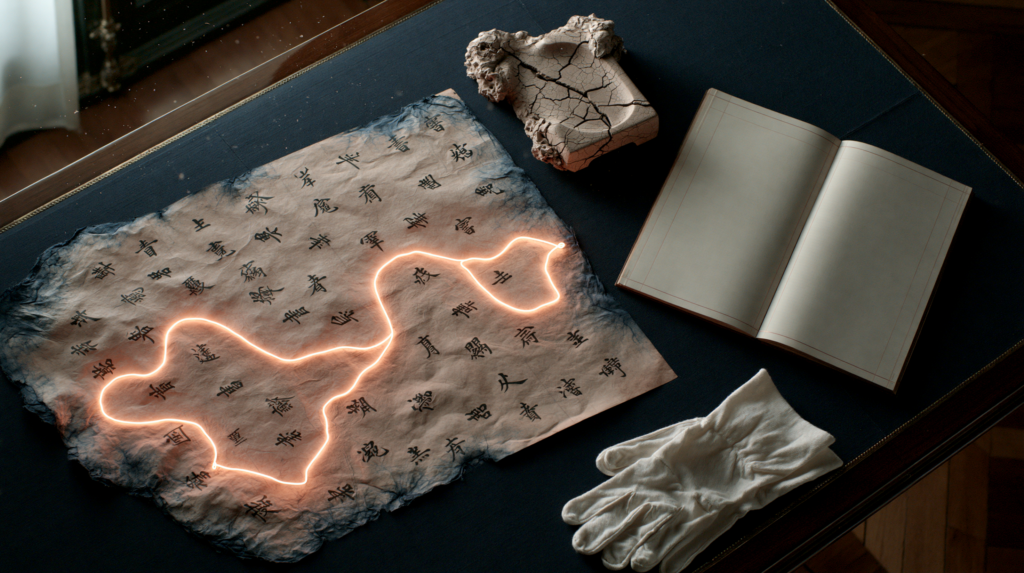
The letters, at least, still exist, in spite of their recent defilement. Twenty-five of them, in a library in Tokyo, characters scattered across their pages in the confidence that the right reader would come. Their withheld order was a trust, held jointly by two people who shared a hand. The withheld order of this digital chirashigaki is a title deed, held singly, and the deed is both method and product. A committee that cannot read has walked the old path to a 0.776 outcome, directed by a coordinator that never saw the page, and the coordinator’s makers, in their own report, would not say which member found the way. If the path is recovered; the hand that scattered it is gone. Somewhere downstream of us, in the fullness of time, a scholar may sit before answers that our infrastructure produced and try to do for them what connoisseurs did for Antwerp’s workshops, prying apart who conceived and who executed and who merely signed, and will discover that this time the reading order was not lost. It was never written.
References
Babbage, C. (1832). On the economy of machinery and manufactures. Charles Knight. https://archive.org/details/oneconomyofmac00babb
Baldwin, C. Y., & Clark, K. B. (2000). Design rules: Vol. 1. The power of modularity. MIT Press.
Braverman, H. (1974). Labor and monopoly capital: The degradation of work in the twentieth century. Monthly Review Press.
Brooks, F. P., Jr. (1995). The mythical man-month: Essays on software engineering (Anniversary ed.). Addison-Wesley.
Carpenter, J. T., & McCormick, M. (2019). The Tale of Genji: A Japanese classic illuminated. The Metropolitan Museum of Art. https://www.metmuseum.org/met-publications/the-tale-of-genji-a-japanese-classic-illuminated
Daston, L. (1994). Enlightenment calculations. Critical Inquiry, 21(1), 182-202. https://doi.org/10.1086/448745
d’Entrecolles, F. X. (1906). Letters of Père d’Entrecolles (W. Burton, Trans.). In W. Burton, Porcelain, its art and manufacture. B. T. Batsford. (Original letters written 1712 and 1722). https://www.gotheborg.com/letters/letters_first.shtml
Feynman, R. P. (1975). Los Alamos from below: Reminiscences 1943-1945 [Transcript of lecture, University of California, Santa Barbara]. Engineering and Science, 39(2). https://calteches.library.caltech.edu/34/3/FeynmanLosAlamos.htm
Grattan-Guinness, I. (1990). Work for the hairdressers: The production of de Prony’s logarithmic and trigonometric tables. Annals of the History of Computing, 12(3), 177-185.
Magurn, R. S. (Ed. & Trans.). (1955). The letters of Peter Paul Rubens. Harvard University Press.
Murasaki Shikibu. (1925). The tale of Genji (A. Waley, Trans.). Houghton Mifflin. (Original work written ca. 1021). https://www.gutenberg.org/ebooks/66057
Narayanan, A., & Kapoor, S. (2024). AI snake oil: What artificial intelligence can do, what it can’t, and how to tell the difference. Princeton University Press.
Piore, M. J., & Sabel, C. F. (1984). The second industrial divide: Possibilities for prosperity. Basic Books.
Sakana AI. (2026). Sakana Fugu technical report (arXiv:2606.21228v1). arXiv. https://arxiv.org/html/2606.21228v1
Smith, A. (1776). An inquiry into the nature and causes of the wealth of nations. W. Strahan and T. Cadell. https://www.gutenberg.org/ebooks/3300
Taylor, F. W. (1911). The principles of scientific management. Harper & Brothers. https://www.gutenberg.org/ebooks/6435
Thinking Machines Lab. (2026, July 15). Inkling: Our open-weights model. https://thinkingmachines.ai/news/introducing-inkling/
Yampolskiy, R. V. (2024). AI: Unexplainable, unpredictable, uncontrollable. CRC Press.
Leave a Reply