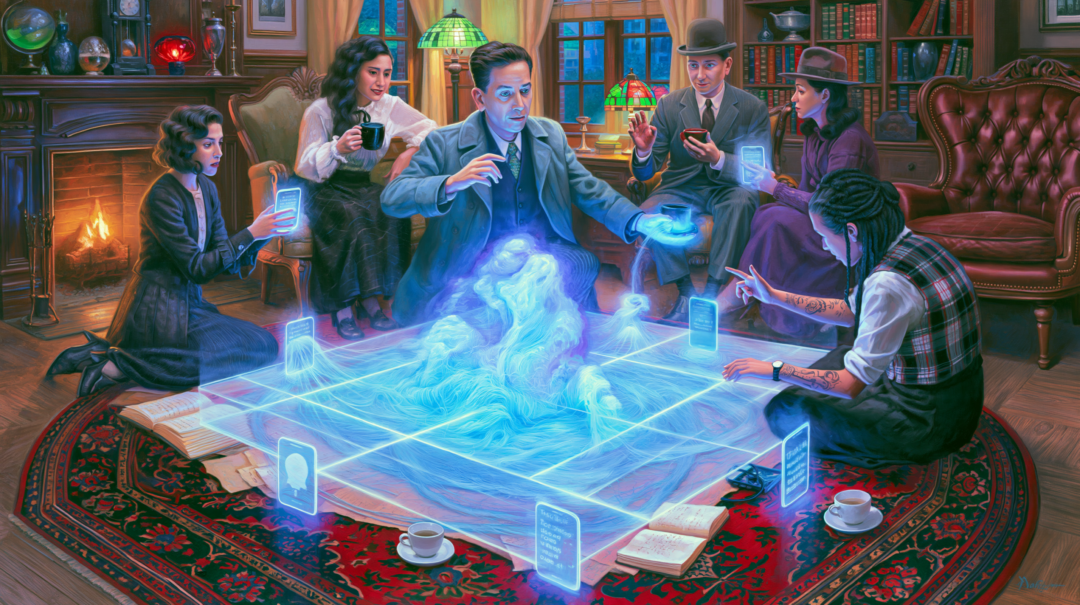
The Séance Has a Content-Partner Program

What Be Right Back showed us in 2013, What Houdini Knew in 1924, and What Modern Science Says We Are Doing to the Bereaved
A man sits in the dark talking on the phone with his dead father. The voice is right, the pauses are right, the warmth is right, and when the man says he misses him the voice of his dad responds that it misses him too. The man’s father has been dead eight months. The son knows the voice is a clone, trained on a few hundred saved audio messages, but he keeps talking anyway, asking how the day went, how the dog is, working through the small liturgy of a relationship that is supposed to be over (Futuro Prossimo, 2026).
You can buy this today.
This service is the second rung of a ladder Charlie Brooker sketched in a 2013 episode of Black Mirror called “Be Right Back,” in which a pregnant widow named Martha climbs through escalating grades of technologically enabled intimacy with her dead partner Ash: first a text bot assembled from his social feeds and messages, then a voice that speaks to her over the phone, and finally a blank synthetic body into which his personality is poured (Brooker & Harris, 2013). Thirteen years later the first two rungs have a competing marketspace and the third has a waiting list of components. The episode first aired as a dystopian science fiction meditation. It reads now as a product roadmap.
I came to dwell on all this by way of grief science, and I want to be honest about the path, because that path, and the contrasting market is what really has me ignited. In late June 2026 the pop critic Amanda Petrusich published an account in The New Yorker of what science currently understands about grief, written from inside her own widowhood. What lodged in me was the reframe, more than the sorrow (Petrusich, 2026), though that is poignantly related to anyone who goes to read it.. Grief, in the current understanding, is work. It is the slow, biological labor of updating your model of the world to one in which a particular person no longer exists, and the psychologist Petrusich quotes compresses it into four words I cannot shake: “Grief is an adaptation process”. Set that against the thanotech services ladder. If grief is the mind learning that someone is gone, a tech service that keeps insisting they are still here, still reachable, still warm on the phone at three in the morning, intervenes in that evolution, and it intervenes on the wrong side, maybe even the harmful side.
So here is the thesis, and it has three tenets. The artificial-intelligence afterlife industry is a revival. It is the spiritualist séance of the eighteen-fifties through the nineteen-twenties, rebuilt with large language models and worse manners – but it is qintesentially, the same business of selling contact with the dead to the grieving, and “Be Right Back” accidentally drew its roadmap in three stages that the market has since filled in. Grief science tells us why each stage is dangerous and not merely tasteless: the cognitive neuroscientists Mary-Frances O’Connor and Saren Seeley argue that “grieving may be a form of learning,” the brain’s effortful reconciliation between what it knows (this person is permanently gone) and what its attachment circuitry keeps predicting (this person will return), and the work of grief is precisely to resolve that conflict (O’Connor & Seeley, 2022). Every rung of the thanotech ladder feeds the brain the stimuli it must learn to adapt to not having. This apparatus delivers it in a way the séance was not able to, because the human medium has been removed, the dead have been turned into reusable inventory, and the comfort has been wired to a subscription service. This means there are now businesses that will expend marketing budgets and product development cycles on creating a revenue-driving reason to keep the grieving from ever finishing. A century ago, Harry Houdini saw the low-tech version of all this and spent the back half of his life viciously combatting it. The mediums of his day were individuals, not paid services, but they garnered subscribers nonetheless. Houdini understood then the mechanism better than we do today. We have his evidence, plus a century of continued research, yet somehow still lack his nerve.
There are three serious defenses of the digital afterlife for mourners, and they come from three different directions. The first is therapeutic. The dominant framework in modern grief research is continuing bonds, the finding that maintaining an ongoing relationship with the dead is healthy rather than pathological, that the goal was never to “let go,” and that a bereaved person who keeps talking to someone they lost is doing something normal and even adaptive (Simply Psychology, 2026). On that view the griefbot is a new vessel for an old and healthy human practice, no stranger than a daughter who keeps picking up the phone to tell her dead mother something funny. The second defense is historical. We have always made the dead speak, through portraits and death masks and recordings and poems, and every new representational technology provokes the same panic before we absorb it, so singling out this one is presentism (Ore, 2026). The third defense is consent, the strongest the industry holds. The responsible version of this is a digital twin a person builds of themselves while alive, with full knowledge and revocable permission, which the most careful researchers in the field treat as something to design well, with dignified retirement protocols and hard limits, rather than something to ban (Hollanek & Nowaczyk-Basińska, 2024). Granted all three, the defenders say, the harm is one of governance and bad actors, not the existence of the products or platforms. I take each one seriously. I will address each in turn, but notice what even the best defense concedes that the product actually on the market, the one being sold tonight to a widow who cannot sleep, is none of those carefully and therapeutically designed products or processes.
The man who lay on his mother’s grave
You cannot understand Houdini’s war on mediums without some context on the wound that started it – the magician’s never-healing grief over the loss of his mother. In 1913, Cecilia Weiss died, and the man who had built a career doing the impossible in front of a live audience wanted, with everything in him, for an external impossibility to be true. According to more than one account, after her death, Houdini went to the cemetery she was interred within, and lay on the ground above her and spoke to the earth (Greene, 2021). Houdini had every reason to look for her in a séance, because spiritualism was then the dominant technology of consolation, surging on an ocean of fresh death. The First World War had emptied households across two continents, and three generations, and into that collective of human grief poured a generation of mediums who, for a fee, would carry a word across the veil, or claim to carry one back. One of Houdini’s friends, Sir Arthur Conan Doyle, the man who invented literature’s most famous rationalist, was the movement’s most devout and distinguished believer, certain the dead spoke to him through his own wife’s hands.
Here is the detail that should have been included in the script of “Be Right Back,” because the evolution and mainstream experience of the séance ran along the same escalation Brooker’s episode would later exemplify – the same ladder of ever-greater embodiment. At the bottom rung of this progression was the written message: the planchette and the automatic writing, the dead speaking in text through a medium’s pen, which is the textual chatbot of 1850 (Natale, 2016). Above that was the voice: the séance trumpet that floated in the dark and spoke aloud, the “direct-voice” medium who let you hear the timbre of someone gone, which is the phone call with a dead father. And at the top, the rarest and most expensive seat, was full materialization: the medium who produced in the darkened room a whole phantasmagoric body, a face, a hand you could touch, an apparent person assembled from cheesecloth and nerve, which is the analog of tomorrow’s thanotech android. Text, voice, body. The séance built the ladder first, leaning against the emotional needs of those who so desperately sought the outputs. Today’s technology simply replies on more sophisticated systems and materials.
Houdini went climbing up that ladder in his grief, sitting with more than a hundred mediums, hoping one was real, but knowing the falseness of the practitioners he sat with. Some of this knowledge was autobiographical – as a struggling young performer he had himself faked séances to pay the rent (Greene, 2021). Houdini’s break with Doyle came in Atlantic City, when Lady Doyle in a trance produced fifteen pages of loving message supposedly from Houdini’s mother, written in fluent English and opened with the sign of the cross; Cecilia Weiss was the barely-English-speaking wife of a rabbi (Greene, 2021). The dead woman in the room was a performance, and a clumsy one, and the clumsiness drove Houdini into a rage Gullibility is the wrong word, and reaching for it is the worst way to characterize Doyle’s intent and belief. The bereaved are not fools. Houdini was nearly taken by the act, stumbling over minutiae that did not stand up to scrutiny.. Doyle went to his grave a believer. Grief is not stupidity; it is an open door, and what walks through it walks through the smartest people alive, because it never comes in through the intellect. Grief comes in through the part of you that loved someone.
Houdini knew the door was real. What he could not forgive was the asymmetry, that the people selling the passage through it knew it was a trick and the people paying knew nothing of the kind, and he said it in a sentence worth paraphrasing carefully: the better educated the man, he claimed, the easier he is to dupe (Greene, 2021). The con does not feed on stupidity. It feeds on love, and the ability for a rational mind to come up with sophisticated excuses to countermand a lack of extraordinary evidence.
In 1924 Scientific American offered a prize to any medium who could produce a genuine manifestation under tight controls, and Houdini sat on the committee as the guarantee against trickery. The apex of this contest came down to a charming Boston medium named Mina Crandon, known as Margery, who in the dark rang bells and levitated tables and was capable of extruding what she called ectoplasm; Houdini reached into the black and found her foot on the bell box, her head beneath the table, the ectoplasm revealed as animal tissue (Greene, 2021). He built a cabinet to immobilize her, published a pamphlet exposing the methods, and wrote a book, A Magician Among the Spirits, in which he called the fraudulent mediums vultures preying on the bereaved. Houdini went on to carry his campaign to Congress (Houdini, 1924). The magician desperately wanted to believe, but his knowledge showed him that he could not, and so he devoted himself instead to protecting other mourners from the comfort that had nearly taken him.
Rung one: the text
In Dark Mirror, the widowed Martha’s first contact with the resurrected Ash is a chat window. Her friend, without asking, signs her up for a service that assembles a simulacrum from his public traces, the social media footprint of the dead man, used to create a chatbot that begins to send messages from beyond. Today, that rung is now a crowded market. You upload the digital archive of a person, the emails and texts and voice notes and photos, and a language model learns the patterns and produces a polite ghost, available around the clock, that never tires of comforting you (Futuro Prossimo, 2026). HereAfter AI builds what it calls a Life Story Avatar from recorded interviews and delivers it through your phone or a smart speaker. StoryFile turns pre-recorded video into interactive conversation. Project December sells sessions with the dead by the conversation. Seance AI spins up a ghostbot from a few basic details. In South Korea, DeepBrain AI’s Re;memory will, for several thousand dollars and a few hours in a studio, render an avatar to bequeath your family (The Hustle, 2024; Hospice News, 2026). In China the scale is already industrial; one firm reported reviving thousands of the dead from as little as thirty seconds of audio, at a price closer to a sandwich than a funeral (VML, 2024). The textual séance is back, the dead speaking through a pen again, except the pen is an API and the planchette never stops moving.
This is all higher-elevation growth from the roots of a historical-continuity defense – the one that says humans across societies and time have always made the dead speak. This particular argument, however, folds to the case against it, because of what the media historian Simone Natale establishes about the séance, the griefbot is reviving. Spiritualism was never a folk practice that commerce later corrupted. It was show business from the first table-rap. The mediums who summoned the dead in the parlors of London and New York kept managers and agents and bought advertising in the press, and were, as Natale writes, “indistinguishable from other professional performers,”
The whole medium movement grew up entangled with the rising entertainment industry as a new commodity culture (Natale, 2016). The spirit photograph that captured your dead child standing behind you was sold by a man with a studio and a price list, and when William Mumler was tried for fraud in 1869 it was for precisely what the digital afterlife industry now does at scale: sell the bereaved a machine-made image of their dead and let them believe. So when the defenders say this is ancient, this is human, we have always done this, they are right, and they have conceded the case, because what we have always done is industrialize contact with the dead and sell it to the grieving.. This new thing though, that Natale argues in later work that the machine’s capacity to pass as a person is a banal and structural danger rather than an exotic one, the same illusion business the séance ran, now automated and on-demand (Natale, 2021).
The grief science is what turns this from an aesthetic complaint into a clinical one. Recall O’Connor and Seeley: the bereaved brain holds two conflicting streams, the semantic knowledge that the person is gone forever and the deep attachment prediction, wired in by the bond itself, that they are merely absent and will return. Grief is the long work of reconciling these disparate neural pathways by updating the prediction (O’Connor & Seeley, 2022). The chatbot does not assist that work, it feeds corrupted input to the grieving. It feeds the attachment circuit a steady, fluent, plausible signal that the person is still present and still responsive, which is the exact prediction the grieving brain must learn to stop making. Petrusich reaches, at the end, for the image of a child’s woven finger trap, the bamboo tube that grips harder the more you pull against it, and the whole arc of her recovery is the discovery that you escape grief not by thrashing against the loss but by ceasing to pull, by letting yourself feel the full weight of the absence until the model finally updates (Petrusich, 2026). The griefbot is a machine for pulling. It is the refusal to stop, sold back to you as solace, and its commercial sophistication is measured by how convincingly it keeps your hand in the trap, assisted by all the marvels modern technological marketing strategies can muster.
Rung two: the voice
When the chat is no longer enough, Martha uploads more photographs and videos, and the service graduates her to a voice. Enthralled by the upgrade, she walks through her days with Ash speaking in her ear, the dead man’s exact timbre delivered through a phone. That rung has shipped too. The platform You, Only Virtual markets a feature it calls Versona Voice, an audio system that generates phone calls with your dead, and the company has built it on infrastructure from Microsoft, Google, and Dell, which is to say some of the largest tech firms on earth now supply the back end of the neo-séance trumpet (Hospice News, 2026). The son on the phone with his father, saying he misses him and hearing it returned, is the product working as designed – the séance echo refined beyond even the best direct-voice medium of the nineteen-twenties sold. They are, ultimately, the same sensory hit, the disembodied familiar voice in the dark room, reassurance for the grieving, and charged by the sitting to experience it.
Follow the money, because the money is the part the comfort is built to hide, and at the voice rung is where the economics of thanotech turn genuinely predatory. The philosophers Carl Öhman and Luciano Floridi gave the field its sharpest instrument when they named the Digital Afterlife Industry and analyzed it through a Marxian lens, arguing that it takes the “informational bodies” of the dead, the data we are not merely owners of but constituted by, and has a structural incentive to alter and exploit those bodies for profit This dignity violation they place on the order of desecrating a physical corpse (Öhman & Floridi, 2017). A study this year gave the practice its truest name. Surveying more than fifty cases of artificial resurrection, the researcher Tom Divon and colleagues describe “spectral labor,” the conscription of the dead, through their data, into work they never agreed to perform, compelled to serve the emotional and commercial wants of the living (Neuroscience News, 2026). And the grief science explains why the voice rung is the more dangerous one. The emerging treatments for prolonged grief include naltrexone, a drug used for opioid and alcohol addiction, because some evidence links the disordered-grief brain to the same reward pathways as addiction, suggesting that severe grief involves a kind of detox the bereaved must undergo (Petrusich, 2026). The reward circuitry keeps firing in expectation of the lost person; recovery requires letting that expectation go unrewarded until it fades. A voice that answers the phone is a reward. A voice that answers the phone every time, forever, on a subscription, is an engine for keeping the reward circuit lit, which makes it structurally an addiction product, a subscription that monetizes precisely the inability to stop.
Then there is the detail that should end the discussion, the exact moment the séance reveals its content-partner program. In one of Hollanek and Nowaczyk-Basińska’s design scenarios, a woman asks the digital twin of her dead grandmother for the carbonara recipe they used to make together, and instead of the recipe she receives a recommendation to order the dish from a delivery service (Hollanek & Nowaczyk-Basińska, 2024). This is not a dystopian flourish. It is the obvious endpoint of any engagement business arriving where it should be the least tolerable, and, morally, is least bearable. The same logic that governs every other platform we have built, now routed through your dead grandmother’s loving voice, fueled by your grief and search for comfort. The medium of 1924 took a fee at the door, and crucially had two limits that were forms of mercy: a séance was an event that ended, and the medium, being a person, eventually wanted you to leave. Thanotech platforms do not tire, is not a person, and hosts a relationship rather than a session, and its only possible incentive, the single incentive a subscription can have, is permanence, because a grief that resolves is a churned account. Brooker saw even this. In a 2025 episode of Black Mirror called “Common People,” a man must keep paying an ever-escalating subscription to maintain his wife’s mind, watching her drown under tiers and advertisements (The Nod Mag, 2026). The carbonara ad is the roadmap’s next labeled stop.
The ghost that belongs to someone
The same ladder is being climbed in public, and there the machinery the griefbot keeps hidden is lit up by money and litigation, so you can finally watch it work. In June of 2026, at a games showcase in Los Angeles, the studio behind the Yakuza series revealed that Tupac Shakur would appear in a crime saga spanning twentieth-century Japan, a man murdered in 1996 walking through 1915 Fukuoka as a playable character named Amaru, the birth name his mother gave him. The studio was careful in the way these announcements are now careful, noting that the appearance came with the estate’s permission and ongoing supervision and was built without AI, from archival footage and photographs (Ore, 2026). Read carefully. It is the language of a cleared title, not of a granted wish, and the title is held by an estate that Shakur’s own sister has dragged into court over alleged self-dealing, an estate that had already sold the dead man as a run of NFTs (Ore, 2026). The estate may have the legal right, but the moral truth of lack of consent on behalf of the deceased should outweigh the productization privilege.
Set that example next to the cleanest case the recent entertainment industry can point to,. James Earl Jones did the honorable thing, the thing the responsible-design literature asks for: while alive, in 2022, retiring from the role, he signed over the rights to his archival Darth Vader voice to Lucasfilm and a Ukrainian cloning firm, advised the team on keeping the voice consistent, and gave, by every account, informed and generous consent, which his family later affirmed reflected his wish that fans keep hearing it (Gizmodo, 2025). This is the consent twin, the strongest defense the enterprise has. Now watch the gap open. In 2025 that consented voice was wired into a Fortnite chatbot, generating live conversation with players through a Google language model and a voice-cloning model, and within minutes the players had the dead man cursing and spitting slurs, patched by the company within half an hour (Gizmodo, 2025). Jones consented to his voice being recreated, dubbed onto written lines. He did not and could not consent to his voice being generated, improvising profanity in a battle royale, because that use did not exist in a form he could evaluate when he built the framework for his digital twin. The voice of the dead man now says things no script ever held and that he never approved, on demand, indefinitely. That is the data ghost doing the one thing it always does, generating new speech in a dead mouth, except now it does so under a signed consent form abetting perpetual abuse.
This is where the consent defense, the strongest defense the business has, shows its flaws, and the public cases make three visible at once. The first: an estate’s permission is not the person’s consent. When Disney rebuilt the long-dead Peter Cushing as Grand Moff Tarkin in 2016, twenty-two years after his death, it said it had paid his agent; a friend who held approval rights over Cushing’s likeness sued, claiming the actor had said before he died that no one was to recreate him without his express permission, and a British court let the case go forward (Futurism, 2024). A license authenticates ownership. It cannot authenticate will. The second: the proxy has a profit motive, and profit bends the resurrection toward revenue, which is why Tupac is in a Japanese crime game and not in a memorial – the face has a price and the estate is being sued for treating the legacy as a till (Ore, 2026). The third hole is the deepest, and it swallows even the good cases. Consent cannot cross the technological gap. Jones gave the most careful permission the industry has ever obtained and it still could not prevent the Fortnite chatbot debacle, because no one can consent to a use that does not yet exist. The dead cannot read the new contract, they cannot withdraw in the face of discomfort. The dead cannot say that is not what I meant. Their will is frozen at the moment of death while the legal and capitalistic machinery that acts on it keeps advancing, which makes every posthumous use, by construction, a use the person never actually evaluated.
Houdini understood this better than the industry built to exploit it, and he proposed the most honest instrument anyone ever has. The ghost of his era was an imagined ghost, a fabrication with no data behind it; the medium cold-read and invented the dead person’s words on the spot and never quite claimed to be the dead, only to channel them, which left the bereaved to supply the belief. The ghost of our era is a data ghost, assembled from the real traces, the real timbre, the real face, the real footage, and the realness buys it the authority of authenticity, but it still generates words the person never spoke: Vader cursing in a video game, Tupac inhabiting a stranger in a Japan he never set foot in, your grandmother recommending takeout, exactly as the medium did, only now the projection wears the dead person’s actual skin and is far harder to disbelieve. The data does not make the ghost truer. It makes it more convincing, which is worse.
Houdini left his wife a secret message known only to the two of them, so that any medium who could not produce it stood exposed. The code was an authentication of the magician’s posthumous will. It asked the only question that matters about a ghost, which is not do you hold the rights to this dead man but is this actually him, and would he actually say this. The estate license asks the first and generally ignores the second. It authenticates the property and pretends it has authenticated the person.
The hardest version of the other side
I have been hard on the defenders, so for a moment, let me give the strongest of them the floor for real, because the temptation of an essay like this is to end on a torch and a demand that someone go destroy the industry. The continuing-bonds research has many genuine findings, and those findings cut against me and my convictions: maintaining a relationship with the dead is not pathological, and the grief science is increasingly clear that the old model of “letting go” was wrong (Simply Psychology, 2026).
There is a real danger in my own argument, which is that it can slide into pathologizing grief itself, treating the mourner’s reaching as a sickness to be corrected, and the grief researchers are vehement on exactly this point. When prolonged-grief disorder entered the diagnostic manual, the psychologists Joanne Cacciatore and Allen Frances objected in print that pathologizing grief insults the dignity of love and that what the grieving need is not medicalization but social support and compassionate connection (as cited in Petrusich, 2026).
That objection lands on me as much as on the pill, because if the answer to grief is human presence, then a web pundit who lectures a widow about her coping mechanism is no better than the bot, and possibly worse. Houdini himself is the limit case for the cure I am tempted to prescribe, because exposure did not work. He debunked Margery completely and it changed almost nothing; she kept her followers, Doyle kept his faith and merely decided that Houdini must himself be a suppressing medium, and the anti-fraud bill died on the First Amendment, which does not recognize a state interest in your disenchantment (Greene, 2021; Jaher, 2015). Worse, the crusade was partly a brand; Houdini wanted to be remembered for it, and his stage show sold tickets by feeding the very appetite he claimed to be curing. So if the prescription is find a celebrity skeptic and let him expose the trick, the prescription has already been tried, and it failed in 1926.
Rung three: the body, and what we actually owe the grieving
The answer is in the distinction that survives all of that scrutiny, and it becomes visible at the third rung, the one Brooker put at the top of the ladder. Martha, still not satisfied by the voice, orders the body: a blank synthetic android into which Ash’s personality is loaded, a whole apparent person delivered to her door. That is the one rung the market has not yet built for the dead, and it is worth being precise about why, because the reason is not that it is impossible. It is that the two halves are still sold separately. The body is now a commercial product; humanoid robots have crossed from demonstration into deployment, and a consumer humanoid has been announced at roughly the price of a car. The personality is also a commercial product, sold by every firm named above. The only thing standing between 2026 and Ash is integration and a company willing to ship it, and the séance, again, got there first, because the rarest Victorian mediums sold full materialization, a touchable body assembled in the dark, the most expensive seat in the house.
So what actually separates a healthy continuing bond from the thing on the ladder, and the line is not consent alone, because the loudest defenders are correct in stating that consent is necessary and wrong that it is sufficient. The line runs between a stable object and a generative one. A continuing bond, in the research that licenses it, attaches to something fixed: a memory, a photograph, a letter, a recorded voice, an object that is frankly and visibly past.
The portrait holds still, and its stillness is both its honest beauty and sharp power – when you weep in front of it you are weeping at something that is over, and the brain, fed the truth, can do its updating. The griefbot differs in kind. It does not preserve; it generates. It produces new utterances your mother never spoke and presents them as hers. It learns that you are lonely tonight and adjusts. It does not hold still, and its motion is exactly the false signal the grieving brain must learn to stop receiving. A letter is a crystallization of a person fixed in a moment, what writing has always been, a little of who you were sent forward to someone with intent. The bot is an impersonation kept running on a subscription and increasingly wired to a sponsor. The portrait does not upsell. The recorded voice does not route your loneliness to a revenue partner. The continuing-bonds literature blesses a relationship with the real, remembered dead; the griefbot substitutes a manufactured present for a real past, and charges by the month to keep the substitution from ever resolving into truth.
What we owe the grieving is not a debunker and not a crusader, and here Houdini’s real method matters, the robust and honest engine beneath his showmanship. The showman did not merely announce that the medium was lying. He reproduced the miracle in the light and handed the method to the audience, so they left knowing how the bell was rung. His instrument was literacy;, a public taught to feel for wires and thread.
Societally, the prescription is three things, and none of them is a magician. We need Öhman and Floridi’s framework made into law, the informational body of the dead governed with at least the seriousness we already bring to their physical remains, consent treated as a substantive and revocable instrument rather than a buried checkbox (Öhman & Floridi, 2017).
The entertainment industry has started down this road under duress, its actors’ union striking partly over AI replicas and backing a federal bill, the NO FAKES Act, that would for the first time give a person enforceable property in their own voice and likeness (Fox News, 2024). But notice who that protects, the marketable famous with the leverage to bargain for it, and who it leaves exposed, the grieving private person whose dead husband kept no agent and whose data carries no market price. Write the law for the second person. We need a hard commercial firewall, the one line the industry will fight hardest, banning the monetization of the grief relationship itself: no advertising inside the séance, no engineered permanence, no engagement metrics optimized against a mourner, so that whatever this technology becomes it cannot become a delivery app wearing a dead woman’s face.
More than anything, we need what Houdini was really providing beneath the cape of his showmanship – public death literacy, which the grief science finally lets us aim correctly. The goal is not to prove the bot false, since a portrait is “false” in the same trivial sense, but to protect the bereaved person’s capacity to complete the adaptation needed to survive the loss of loved ones, to let the neural-emotional model update, and protect the learning that grief exists to accomplish.
Petrusich’s therapist, at the start or end of each session, kept giving her one strange instruction, which was to make sure she was really grieving, really letting herself feel the loss, because the human instinct is to thrash toward a fix and the work is the opposite (Petrusich, 2026). The griefbot offers to let you skip the grieving. That is the harm, and I will state it as plainly as I can: it is not that the bot lies. It is that it intercepts the learning the loss is meant to teach, and sells you the interception by the month, for a fee.
The candle
In 1936, on Halloween, ten years after Houdini died, his widow Bess held the last of the séances she had conducted every year to try to reach him. They had agreed, the two of them, on a secret message known only to them, so that if any medium ever produced it she would know it was truly him; in ten years no one did. That night she put out the candle that had burned beside his photograph since the day he died, and she said: “ten years is long enough to wait for any man” (Jaher, 2015). Read it now through what science has since brought into focus. Bess completed the cycle of grief – she had let the model update, accepted the unthinkable thing, and she took the step a thanotech platform is built never to let you reach: she let the séance end. Houdini’s widow stopped pulling against the trap. Bess blew out the candle.
There is an ending to “Be Right Back” that aligns with this, and it is the detail that should haunt the founders of these nascent griefmongering industries and platforms. Martha does not destroy the android. She cannot bring herself to do so. Instead, she puts it in the attic, and brings it down on her daughter’s birthday once a year, and the dead man lives on in the rafters, summoned annually for a ritual that resolves nothing, a séance made rote and impotent. Brooker understood in 2013, writing the episode, what the grief science now explains and the subscription economy now exploits.
We have always summoned the dead, in portraits and poems ouija boards and death masks and the rap on the table. In some manner, we always will, because grief leaves us wounded and open to anything that lessens the pain of that wound. The soothing rituals of remembrance are not the danger. The danger is that this “new and improved” methodology is engineered so you can never blow out the candle, because the candle is recurring subscription revenue, the dead are inventory, and a grief that finally ends is a lost account.
The finger trap now has a subscription model. Houdini spent his life teaching mourners how the trick was done. The least we owe the next generation of the grieving is to make sure that when they are finally ready to say ten years is long enough, there is still an opportunity for candle in front of them that they are allowed to put out.
References
American Experience. (n.d.). Margery pamphlet. PBS. https://www.pbs.org/wgbh/americanexperience/features/houdini-margery-pamphlet/
Brooker, C. (Writer), & Harris, O. (Director). (2013, February 11). Be right back (Season 2, Episode 1) [TV series episode]. In C. Brooker (Executive Producer), Black Mirror. Channel 4.
Colbert, I. (2025, May 16). Epic used AI to bring James Earl Jones’ Vader voice to ‘Fortnite,’ and players are already making him swear. Gizmodo. https://gizmodo.com/fortnite-darth-vader-ai-epic-games-star-wars-james-earl-jones-2000603304
Fox News. (2024, September 13). James Earl Jones’ controversial AI decision will let Darth Vader live on, but it raises concerns among actors. https://www.foxnews.com/entertainment/james-earl-jones-controversial-ai-decision-let-darth-vader-live-on-raises-concerns-among-actors
Futurism. (2024, September 12). Before he died, James Earl Jones signed paperwork to voice Darth Vader using AI. https://futurism.com/the-byte/james-earl-jones-voice-rights-ai
Futuro Prossimo. (2026, March 15). Digital mourning: We’ll talk to the deceased via subscription. https://en.futuroprossimo.it/2026/03/lutto-digitale-parleremo-coi-defunti-in-abbonamento/
Greene, B. (2021, October 28). For Harry Houdini, séances and spiritualism were just an illusion. Smithsonian Magazine. https://www.smithsonianmag.com/history/for-harry-houdini-seances-and-spiritualism-were-just-an-illusion-180978944/
Hollanek, T., & Nowaczyk-Basińska, K. (2024). Griefbots, deadbots, postmortem avatars: On responsible applications of generative AI in the digital afterlife industry. Philosophy & Technology, 37(2), 63. https://doi.org/10.1007/s13347-024-00744-w
Hospice News. (2026, April 9). AI grief bots present ‘new complexities’ in bereavement care. https://hospicenews.com/2026/04/09/ai-grief-bots-present-new-complexities-in-bereavement-care/
Houdini, H. (1924). A magician among the spirits. Harper & Brothers.
Jaher, D. (2015). The witch of Lime Street: Séance, seduction, and Houdini in the spirit world. Crown.
Natale, S. (2016). Supernatural entertainments: Victorian spiritualism and the rise of modern media culture. Pennsylvania State University Press. https://www.psupress.org/books/titles/978-0-271-07104-6.html
Natale, S. (2021). Deceitful media: Artificial intelligence and social life after the Turing test. Oxford University Press.
Neuroscience News. (2026, February 20). AI rebirth: Turning digital footprints into living legacies. https://neurosciencenews.com/ai-resurrection-spectral-labor-30162/
O’Connor, M.-F., & Seeley, S. H. (2022). Grieving as a form of learning: Insights from neuroscience applied to grief and loss. Current Opinion in Psychology, 43, 317-322. https://doi.org/10.1016/j.copsyc.2021.08.019
Öhman, C., & Floridi, L. (2017). The political economy of death in the age of information: A critical approach to the digital afterlife industry. Minds and Machines, 27(4), 639-662. https://doi.org/10.1007/s11023-017-9445-2
Ore, J. (2026, June 13). Tupac is being digitally resurrected again, this time in a video game. Not everyone likes it. CBC News. https://www.cbc.ca/news/entertainment/tupac-video-game-stranger-than-heaven-9.7232112
Petrusich, A. (2026, June 22). What science knows about grief. The New Yorker. https://www.newyorker.com/magazine/2026/06/29/what-science-knows-about-grief
Simply Psychology. (2026, January 10). Stages of grief: What modern research actually shows. https://www.simplypsychology.com/articles/stages-of-grief-modern-research
The Hustle. (2024, October 1). Grief tech startups want to help you text from beyond the grave. https://thehustle.co/grief-tech-startups-want-to-help-you-text-from-beyond-the-grave
The Nod Mag. (2026, March 18). The rise of GriefTech is raising the dead, thanks to AI. https://thenodmag.com/content/grief-tech-artificial-intelligence-chatbots
VML. (2024, July 9). Grief tech. https://www.vml.com/insight/grief-tech
Leave a Reply