The Reader Must Survive

There is only an infinitesimal chance that the plaque will ever be seen by a single extraterrestrial, but it will certainly be seen by billions of terrestrials.
B. M. Oliver, quoted in Carl Sagan, “For Future Times and Beings,” Murmurs of Earth, 1978
On the fifteenth of October a French company named Biomemory announced its first commercial product, a service it calls DNA Shield, and the press release reads like a talk therapy pitch for the anxious institution. A customer selects the records it cannot afford to lose, the cryptographic keys and regulated files and what the release calls “institutional memory,” encrypts them, and hands them over; Biomemory then “encodes it into synthetic DNA held offline under managed custody,” and the data rests in a place that, in the company’s phrase, “no single vendor, cloud, or system can reach.” Getting it back is deliberately hard. “Recovery follows a controlled process, deliberately triggered when needed, rather than routine or self-service access” (Biomemory, 2026). The release does not mention a price. A trade reporter found one: “a subscription that starts at €10,000/month,” for a medium with what he called, carefully, “potentially” a 150-year lifespan (Cawley, 2026).
I keep returning to the cost-benefit analysis. Ten thousand euros a month, for a century and a half, comes to eighteen million euros, paid to a firm that named a new chief executive this July. The medium is sold as the most durable ever devised, but the contract that ensures it stays viable renews every thirty days.
Biomemory is not alone in the paradox. In March, six months before its own corporate reinvention, the American firm then called Atlas Data Storage announced a partnership with the Belgian chip laboratory imec under the headline “Next Generation, Permanent DNA-based data storage for the AI Age,” and the release explained the permanence: magnetic media “requires data migration due to media deterioration,” whereas DNA “remains stable for thousands of years when properly encapsulated, meaning stored data never needs migration.” Its boilerplate called DNA “the ideal media to keep data safe – forever.” In the same document the company’s chief operating officer conceded that for any of this to be viable, “the synthesis throughput needs to scale by several orders of magnitude over today’s approach” (Atlas Data Storage & imec, 2026). By September the company no longer used that name. It had become AtlasBase, under a chief executive appointed in March to replace the founding chief executive, who had left about seven months after the spin-out (Mellor, 2026).
What these companies sell is a small object, a droplet or a dried pellet sealed in a stainless-steel capsule, which no one can read by looking at it. A clay tablet can be held to the light and a phonograph record turned in the hand, its grooves visible to anyone who cares to look. The DNA capsule shows nothing at all to the naked eye, and whatever is written inside must be taken on trust from the people who sealed it.
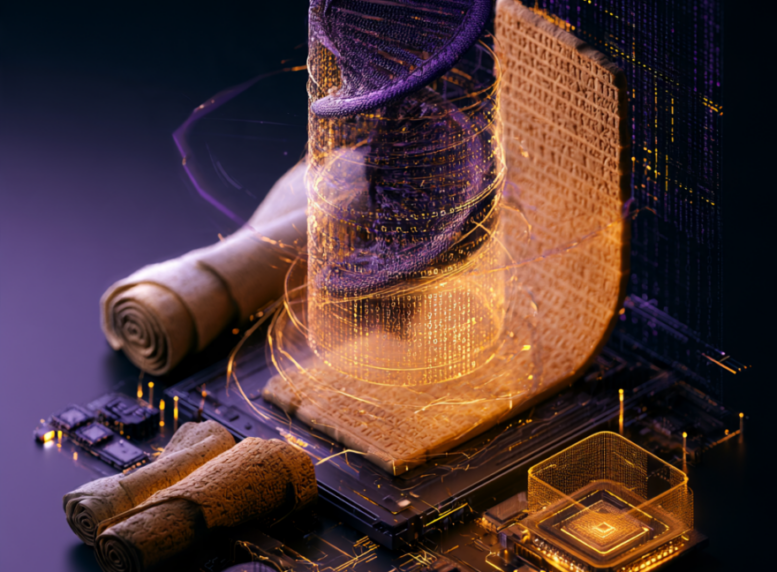
Every message sent toward a reader who does not yet exist has to solve two problems. The medium must survive, and so must the key, meaning the knowledge of how to turn marks back into meaning. Ashurbanipal’s library at Nineveh, by the account that has been told for a century and a half, solved the first problem by accident when the city burned and the clay tablets in the library hardened, and failed the second for something like two thousand years, until nineteenth-century scholars learned to read cuneiform again. The Voyager Golden Record of 1977 was designed with both problems in view; its makers engraved instructions for playing it on its own cover and stowed the cartridge and stylus in the spacecraft beside it. DNA data storage privatizes the wager first visible in the Golden Record. It solves the medium-viability problem chemically and outsources the key problem to a market, so that custody of the only copy migrates from the object to whoever owns the means of reading it.
Voyager wrote to strangers, possibly to no one, and Nineveh to its own scholars and gods. DNA storage writes to future customers, and the companies that hold the key are the companies that will bill them for it. The reader whose survival the medium must presume is now a counterparty to a contract.
In March, at the Library of Congress’s annual meeting on storage architectures, Atlas’s founder Bill Banyai described how a customer would use the product. You send the company your encrypted data, and you “Receive one or more capsules of your data stored as DNA along with boot record and meta data stored as DNA.” To recover the data, you can send the capsule back to Atlas; or you can “Process it yourself with a desktop sequencer” and then “run an open-source script” that returns the digital files; or you can send the capsule to “a certified sequencing center” and run the same script on what comes back (Banyai, 2026, slides 5-6). The decoding instructions are published and the reading machine is a commercial instrument sold to hospitals and universities, while the metadata needed to begin travels inside the capsule with the data. On this account the custody problem has been solved by design, and the Golden Record’s cover has been rewritten into the molecule.
In 2013 Nick Goldman, Ewan Birney and their colleagues at the European Bioinformatics Institute encoded Shakespeare’s sonnets, a photograph and an audio clip of Martin Luther King Jr. into synthetic DNA and titled their Nature paper “Towards practical, high-capacity, low-maintenance information storage in synthesized DNA” (Goldman et al., 2013). The phrase “low-maintenance” carries the whole case. A tape format dies when its drives stop being manufactured; a disk dies when its interface disappears. DNA cannot become obsolete in that way, because reading it is the central activity of molecular biology and the daily work of clinical medicine. Cuneiform became illegible because everyone who could read it died. DNA’s readers are the health systems of every industrial society, and they are not going anywhere. If the sequencer is as permanent as medicine, the key is as permanent as the sequencer.
I grant most of this. DNA is the densest and most durable writable medium on offer, an open-source decoder is better than a secret one, and a boot record inside the capsule is a real piece of engineering foresight.
“Nineveh was consumed by fire in around 612 BC,” wrote Jonathan Taylor, a curator in the British Museum’s Middle East department, in a 2018 essay for the museum, and he gave the fire its famous role in the story: “while paper books are destroyed by fire, the clay tablets were in most cases baked harder” (Taylor, 2018). The library’s survival has long been told as an accident of violence. Ashurbanipal, who ruled from 668 to around 627 BC, amassed a library in his palace, and Abby Smith Rumsey reports that more than thirty thousand tablets survive from its ruins in the museum’s collection (Rumsey, 2016, p. 24). Austen Henry Layard made the first large find in 1850 (Taylor, 2018), and the tablets then waited for scholars who could read them, the key having died with the scribes.
That account has been revised in this year’s volume of Archaeometry, and one of the revisers is Taylor himself. Mathilde Jean, Michela Spataro, Taylor and their colleagues analyzed five tablets and a lump of clay from an elite residence in the city’s lower town, excavated between 2019 and 2023 and never conserved by firing, and found “nonfired or low-fired clays” throughout (Jean et al., 2026, section 3.2). Their discussion goes further than their sample. “Firing was long assumed in library contexts, but the evidence is slight,” they write; the royal Library did burn, with “fire damage in the form of staining and melting of clay tablets,” and yet “it was common practice in the 19th and 20th centuries for tablets to be fired in the field by excavators or at the receiving museum (sometimes without specific records being made).” They conclude that it is “difficult to establish with full confidence what heat treatment, if any, most tablets had received from the scribes in antiquity, during destruction events or following excavation” (Jean et al., 2026, section 4.2).
The archive that supposedly preserved itself by catastrophe owes an unknown share of its hardness to kilns run by its later custodians, and those custodians did not always write down what they did. The maintenance happened, and the record of the maintenance was itself not maintained. A second detail in the paper extends the point back to antiquity. The scribes who wrote these reference works, the authors conclude, “did not source the clay, process the clay by levigation and/or tempering or knead the clay themselves”; they bought their medium “in cooperation with other clay workshops” whose workers left no names on the tablets (Jean et al., 2026, section 4.5).
The Golden Record began from the opposite premise, that durability without legibility produces a sculpture. Carl Sagan describes the arrangement in Murmurs of Earth. “Instructions for playing the record, written in scientific language, are etched on the cover. A cartridge and stylus, illustrated on the cover, are tucked into the spacecraft nearby. The record is ready to play” (Sagan et al., 1978, p. 13). The cover diagram shows the stylus in its starting position and gives the rotation period of 3.6 seconds in units of a hydrogen-atom transition, which a physicist anywhere could recover; it explains how to rebuild the pictures as a raster of 512 vertical lines, and it carries a map locating the sun against fourteen pulsars and a speck of electroplated uranium-238 whose decay works as a clock (Carney, 2024). The uranium was A. G. W. Cameron’s idea, so that recipients could estimate “the length of time that had elapsed since it was launched” (Sagan et al., 1978, p. 11). A vinyl pressing would erode, so the team settled on the copper master from which pressings are made, the “mother” in the trade’s term, and Sagan remarks that “it seemed ideal to send a mother to the stars” (Sagan et al., 1978, p. 14).
Set Banyai’s slide beside Sagan’s cover and the difference shows. The capsule carries a boot record, as the Golden Record carried its diagram, but the boot record is itself DNA and can be read only by the apparatus it is meant to explain. The decoding script lives in a software repository and the sequencing in a certified center, while the chemistry of preparing a sample for the instrument, the primers and reagents and library kits, belongs to an industry that changes its products every few years. Susan Leigh Star wrote that infrastructure “does not grow de novo; it wrestles with the inertia of the installed base and inherits strengths and limitations from that base,” and that its “normally invisible quality” appears “when it breaks” (Star, 1999, p. 382). DNA storage inherits the installed base of genomics, which is a strength, and inherits its upgrade cycle along with it. A sequencer in 2126 will certainly read DNA. Whether it will read the output format a 2026 script expects, prepared with a 2026 protocol, depends on whether someone has kept the script alive in the meantime. Sequencing a molecule yields a stream of bases, and nothing in the stream says how to turn it into a file. The file depends on a chain of software, reagents and paperwork that needs as much upkeep as any tape library.
A decade before these products existed, Rumsey described what preservation professionals do. “The new paradigm of memory is more like growing a garden: Everything that we entrust to digital code needs regular tending, refreshing, and periodic migration to make sure that it is still alive, whether we intend to use it in a year, one hundred years, or maybe never.” She then imagined, as a wish for computer science, the very thing DNA storage now claims to be: a way “to essentially freeze-dry data, to store data at some inexpensive low level of curation, and at some unknown time in the future be able to restore it,” perhaps by storing “not the full file, but the instructions on how to re-create the file, just as the genome does not store an animal or plant itself” (Rumsey, 2016, p. 148). The AtlasBase capsule holds dehydrated DNA, rehydrated when it is read (Mellor, 2026), so her figure has become literal. Her own next page explains why freeze-drying does not end the gardening. “Digital infrastructure is not simply hardware and software,” she writes; “It comprises the entire regime of legal and economic conditions under which these machines run” (Rumsey, 2016, p. 149).
The industry’s own phrase for what it is selling is freedom from that regime. In September, the AtlasBase launch quoted a former chief technology officer of Sony Pictures Entertainment promising preservation “without the constant migration and maintenance that plagues today’s solutions” (AtlasBase, 2026). Atlas’s boilerplate described its technology as “a low-maintenance and environmentally friendly solution” (Atlas Data Storage & imec, 2026), so that Goldman’s careful adjective of 2013 had become, thirteen years on, a line of marketing copy. The adjective did not travel far to get there. One of the 2013 paper’s co-authors, Emily LeProust, went on to co-found Twist Bioscience, the company that spun Atlas out with $155 million in seed financing, and the spin-out announcement placed her on Atlas’s board (Twist Bioscience, 2025). Lee Vinsel and Andrew Russell trace the long lineage of this promise through the idle Maytag repairman of the advertisements and the concrete jacket meant to protect Genoa’s Morandi Bridge, and they sum up its emotional logic in one sentence: “We understand it’s important, but if we had our way, we would never have to worry about it” (Vinsel & Russell, 2020, Chapter 3, “Technology after Innovation”). Archivists have never been allowed that wish. Their profession assumes that preservation is a relationship carried on across generations, which is to say a set of institutions that must keep existing.
DNA Shield shows that the market has two answers to the maintenance problem and has begun selling both. Atlas’s answer was to abolish maintenance by declaring migration unnecessary, which turns upkeep into a one-time purchase. Biomemory’s answer is to sell maintenance back as a service. The customer cannot read the archive itself, cannot trigger its recovery at will, and pays monthly for a firm to hold the molecule, the reading apparatus and the authority to release the contents. The gardener Rumsey described has become a landlord. Seen against the Nineveh scribes who bought clay from a workshop down the road, the arrangement looks less novel; archives have always depended on artisans outside the scriptorium. The novelty lies in the direction of the dependence. The clay workshop sold the scribe a material he then owned and marked as he pleased. The DNA vendor sells the writing, the storage and the reading, and the customer receives a capsule and a contract for help.
Vaclav Smil would say that all of this confuses categories, and he would have numbers on his side. His recurring complaint is that commentators mistake the speed of gadgets for the speed of civilizations: “existential imperatives do not belong to the category of microprocessors and mobile phones” (Smil, 2022, Chapter 7). The archive that the world uses in 2026 is magnetic tape, and it is growing. On the twenty-ninth of October Fujifilm announced that it would invest about ten billion yen at its plant in Odawara “to increase its production capacity for data storage magnetic tape by approximately five times,” on the grounds that “Magnetic tape can store large volumes of data over long periods at low cost” and “can also be physically isolated from networks” (FUJIFILM Corporation, 2026). Air-gapped storage, the selling point of DNA Shield, is already what tape does, at a scale DNA will not approach for years. AtlasBase’s new chip writes, by the company’s own figure, about 250 gigabytes per chipset per day, and the trade editor who covered its launch called the presentation “impressive marketing as well” (Mellor, 2026). Smil’s methodological advice for such announcements is to read them “primarily as evidence of prevailing expectations and biases” (Smil, 2022, Chapter 7), and on his terms a thesis about civilizational custody built on a few capsules of encrypted keys is inflation.
The DNA Data Storage Alliance, an industry and academic consortium hosted by the Storage Networking Industry Association, announced its first two specifications in 2024. Sector Zero, the first, “defines the minimal amount of information needed for the archive reader to identify the CODEC used to encode Sector One, as well as a pointer to the company or organization that synthesized or ‘wrote’ the DNA”; Sector One carries the archive’s metadata (DNA Data Storage Alliance, 2024). If the key is standardized, custody passes from a vendor to a standards body and a community of interoperable implementations, and that arrangement has worked tolerably well for paper sizes, film gauges and the ASCII table.
Smil is right that DNA storage barely exists as infrastructure; the Alliance is right that a standard header is far better than none. Smil’s point about scale cuts the other way, too. A medium that is sold on permanence before anyone uses it at scale is selling a relation to time, since there is as yet very little capacity to sell. Tape’s present dominance also makes DNA’s rhetoric more revealing. The vendors define their product against the “constant migration and maintenance” of tape, which means they are selling an exemption from the archivist’s labor more than they are selling density.
Sector Zero’ does not encode the decoding method in the molecule, as the Golden Record’s cover did for the record. It encodes the name of a codec and “a pointer to the company or organization that synthesized” the DNA. The Rosetta Stone of DNA storage, as the Alliance’s own planning slides call the pair (Landsman, 2026), is a forwarding address. It works for exactly as long as the addressee keeps its name and its doors open.
This year supplied the test case. A capsule written in the spring of 2026 by Atlas Data Storage, had it carried the Alliance’s header, would point to a company that by September was calling itself AtlasBase and describing itself as a “molecular computing company.” The AtlasBase launch release gives its history in a single line, “Founded in 2025 and headquartered in San Francisco,” and does not mention the earlier name at all (AtlasBase, 2026). Startups rename themselves, change chief executives and reorganize their investors constantly. Catalog, once the best-known American firm in the field, now survives as a set of assets inside Biomemory (Biomemory, 2026). The pointer that Sector Zero writes into the molecule refers to an entity whose name, on the evidence of this single year, may not outlast a tape cartridge.
The standards body does not stand outside this churn. One of the Alliance’s co-chairs is Biomemory’s vice president of product management (Biomemory, 2026). Industry consortia are built from the firms in the industry; the people who write standards are the people who build the products. That institutional answer relocates custody from a single firm to the industry as a whole, which gives no independent ground to stand on. The association’s membership and officers change from year to year, and one of its leading members is selling, at the same moment, recovery that is “deliberately triggered” by itself and closed to “self-service access.”
The difference from every earlier durable medium lies in the material. A DNA archive is made of the same molecule as its reader’s body and is invisible at the scale of the body, so the ordinary rituals of archival trust, looking and handling and comparing, are unavailable to it. Trust has to move from inspection to attestation, from what the custodian can see to what the vendor certifies the capsule contains, and the vendor has become the guarantor of both the medium and the testimony about it. When the reading succeeds, the technicians in the certified sequencing center will be as invisible as the assistants in Robert Boyle’s laboratory, whose “work was transparent when the apparatus was working as it should and the results were as they ought to be” (Shapin, 1989, p. 558); when it fails, they will be the first to be blamed. The Golden Record carried its key on its cover. The DNA archive leases its key, and since October it can lease its custody as well, at ten thousand euros a month.
The Golden Record’s makers understood something about their audience that the DNA vendors understand too, though they say it less candidly. Sagan’s consultants told him, and he printed it, that the record’s arrival at another civilization was “chancy at best, while its receipt by the inhabitants of Earth was guaranteed” (Sagan et al., 1978, p. 11). Barney Oliver put it more bluntly in the line that heads this essay. The record’s real function was to give people on Earth a picture of their own civilization as something worth sending, and the production of an introduction card for aliens were the occasion for it. The DNA archive has a terrestrial audience too. Its first readers are the risk officers who need somewhere to put the keys they fear losing, and the investors who need a story about a permanent asset in an industry whose companies keep changing their names. The promise of the next hundred and fifty years is addressed to the present quarter.
Nineveh’s tablets survived the fire, and, it now appears, a later firing by their custodians that nobody fully recorded, and then waited two thousand years for someone who could read them. They were lucky. The scholars who eventually deciphered cuneiform owed nothing to Ashurbanipal’s estate, paid no subscription to his librarians, and needed no pointer to the workshop that sold his scribes their clay. Whoever opens one of this year’s capsules in 2176 will need all three, and will discover, if the scripts and the companies and the standards have lasted, that a medium sold as the end of migration demanded more maintenance than any archive before it. The molecule will be fine. The question is whether anyone will still be paying for the key.
References
AtlasBase. (2026, September 22). AtlasBase unveils molecular computing platform powered by scalable DNA synthesis chip [Press release]. Business Wire. https://www.businesswire.com/news/home/20260922579834/en/
Atlas Data Storage & imec. (2026, March 5). Next generation, permanent DNA-based data storage for the AI age [Press release]. PR Newswire. https://www.prnewswire.com/news-releases/next-generation-permanent-dna-based-data-storage-for-the-ai-age-302705694.html
Banyai, B. (2026, March 10). DNA data storage product update [Presentation slides]. Designing Storage Architectures for Digital Collections Meeting 2026, Library of Congress, Washington, DC, United States. https://digitalpreservation.gov/meetings/DSA2026/0231_banyai_2026.03.10%20Atlas%20LOC%20v1.pdf
Biomemory. (2026, October 15). Biomemory launches DNA Shield, first commercial product built on its molecular IT platform [Press release]. Dark Reading. https://darkreading.com/data-privacy/biomemory-launches-dna-shield
Carney, S. (2024, April 12). Golden Record cover. NASA Science. https://science.nasa.gov/mission/voyager/golden-record-cover
Cawley, C. (2026, October 17). Biomemory’s DNA Shield stores critical data in synthetic DNA – beyond the reach of cyberattacks. TechRadar. https://techradar.com/pro/biomemorys-dna-shield-stores-critical-data-in-synthetic-dna-beyond-the-reach-of-cyberattacks
DNA Data Storage Alliance. (2024, March 12). DNA Data Storage Alliance releases its first specifications for storage of digital data in DNA [Press release]. Storage Networking Industry Association. https://www.snia.org/news_events/newsroom/dna-data-storage-alliance-releases-its-first-specifications-storage-digital
FUJIFILM Corporation. (2026, October 29). Fujifilm to increase production capacity for data storage magnetic tape by five times [Press release]. https://www.fujifilm.com/uk/en/news/hq/14137
Goldman, N., Bertone, P., Chen, S., Dessimoz, C., LeProust, E. M., Sipos, B., & Birney, E. (2013). Towards practical, high-capacity, low-maintenance information storage in synthesized DNA. Nature, 494(7435), 77-80. https://doi.org/10.1038/nature11875
Jean, M., Spataro, M., Taylor, J., Ulian, G., Valdré, G., Giacosa, G., Mariani, E., & Marchetti, N. (2026). A newly discovered tablet-making facility in Nineveh: Insights from scientific analysis. Archaeometry, 68(6), 1294-1305. https://doi.org/10.1111/arcm.70144
Landsman, D. (2026). DNA Data Storage Alliance: 2025 review and 2026 plans [Presentation slides]. Storage Networking Industry Association. https://www.snia.org/sites/default/files/Preview/2026/2026%20DNA%20Data%20Storage%20Alliance%20SNIA%20Preview%20-Final.pdf
Mellor, C. (2026, September 23). AtlasBase makes Thalia DNA computer and storage chip. Blocks & Files. https://www.blocksandfiles.com/data-protection/2026/09/23/atlasbase-makes-thalia-dna-computer-and-storage-chip/5298506
Rumsey, A. S. (2016). When we are no more: How digital memory is shaping our future. Bloomsbury Press. https://archive.org/details/whenwearenomoreh2016rums
Sagan, C., Drake, F. D., Druyan, A., Ferris, T., Lomberg, J., & Salzman Sagan, L. (1978). Murmurs of Earth: The Voyager interstellar record. Random House. https://archive.org/details/murmursofearthvo0000unse
Shapin, S. (1989). The invisible technician. American Scientist, 77(6), 554-563. https://dash.harvard.edu/entities/publication/73120378-877b-6bd4-e053-0100007fdf3b
Smil, V. (2022). How the world really works: A scientist’s guide to our past, present and future. Viking. https://www.penguin.co.uk/books/319141/how-the-world-really-works-by-smil-vaclav/9780241989685
Star, S. L. (1999). The ethnography of infrastructure. American Behavioral Scientist, 43(3), 377-391. https://doi.org/10.1177/00027649921955326
Taylor, J. (2018, October 25). A library fit for a king. British Museum Blog. https://www.britishmuseum.org/blog/library-fit-king
Twist Bioscience. (2025, May 5). Twist Bioscience spins out DNA data storage as independent company [Press release]. https://investors.twistbioscience.com/news-releases/news-release-details/twist-bioscience-spins-out-dna-data-storage-independent-company
Vinsel, L., & Russell, A. L. (2020). The innovation delusion: How our obsession with the new has disrupted the work that matters most [E-book]. Currency. https://www.penguinrandomhouse.com/books/576816/the-innovation-delusion-by-lee-vinsel-and-andrew-l-russell/
Leave a Reply