The Variety He Feared

A man with ALS speaks two million words through a grid of electrodes embedded in his motor cortex. Yet the device, for all its technical brilliance, leaves untouched one of the oldest questions in the history of medicine: who decides where repair ends and modification begins?
Miraculous Engineering
In June 2026, the journal Nature Medicine published a paper titled “Long-term independent use of an intracortical brain–computer interface for speech and cursor control.” Behind that dense, clinical phrasing lay something staggering. A man with amyotrophic lateral sclerosis (ALS) – his voice stolen by a disease that systematically strips away every physical capability – had spent nearly two years using an implanted electrode array to translate the mere thought of speaking into actual words. Two years. Two million words. News reports naturally seized on the most moving detail: he could finally talk to his daughter again. Yet the research team at the University of California, Davis, described him as the system’s first “power user” – a term borrowed from Silicon Valley, treating a restored human voice like a software feature to be optimized.
This is about as morally uncomplicated as medical technology gets. The device delivered exactly what was promised to a patient who wanted it completely, restoring a faculty that a cruel disease had stolen. There is no cultural movement defending ALS-induced muteness. No critic will argue that this man was morally diminished by getting his words back. He was a speaking person who lost his voice; the machine returned what was missing. If you need a case study to prove that physical intervention is an unalloyed good, this is it.
But the very neatness of this case makes it the wrong place to look for the real ethical tension. The miracle stays uncomplicated because capacity and identity align perfectly: restoring his speech restores his sense of self. The real friction occurs when capacity and identity pull in opposite directions – where the condition a machine is built to “fix” is experienced by the person not as a wound, but as an identity. An electrode array or a hearing aid works on the same mechanical principles whether applied to an adult who lost an ability or a child who never had it and never missed it. The divergence isn’t in the hardware; it’s at a crossroads no engineer can calibrate: when a physical difference becomes a culture, what does it mean to cure it?
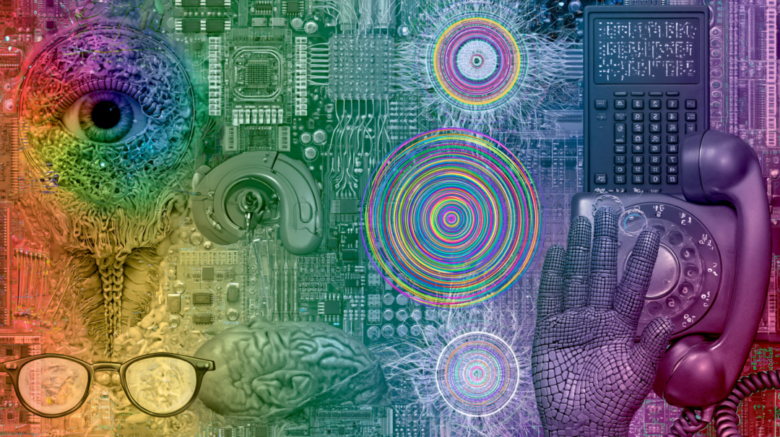
Addressing this question fully requires two histories at once. One is the surface history of the instruments themselves: the eyeglass, the writing machine, the raised dot, the telephone, the implant, the electrode, each sliding from remediation to habit to upgrade until no one recalls it was ever a crutch. The other history is the deep argument running beneath all of them, the one about who gets the right or agency to declare a body deficient. Historically the two meet in a single man, who built the defining communication machine of his century and spent the rest of his life trying to engineer a particular kind of human being out of existence.
Genesis as Repair
Begin with the lens, the instrument we have most completely forgotten was an incalculably unlikely remedy, dependent on multiple tiers of technological and supply-side evolution. Somewhere in northern Italy in the 1280s, in the workshops around Pisa and Venice, someone learned to grind glass into a curve that bent failing sight back into focus. For the first wearers, spectacles were a confession walking to the nonscientific: their eyes had failed and now needed a machine bolted to the face to do their penance, the work of the eyes they were born with. A child in glasses today is not understood to be disabled at all. We have no community of the visually corrected, no culture of the myopic with its own folkways and its own grievances against the sighted, because ocular correction became so total and so cheap and so universal that the underlying difference dissolved into the ordinary range of being a person. The lens never cured myopia. It made myopia a non-issue on most of the first and second world, by making correction invisible. Upon this distinction sits the first innovation the history offers at the crossroads of improvement and augmentation: a remedy good enough erases the very category of deficit it was built for.
The writing machine tells a sharper version of the same story, because it began as an act of love for one disabled person. Around 1808, the Italian inventor Pellegrino Turri built a mechanical writing device for the Countess Carolina Fantoni da Fivizzano, who was blind, so that she could write legible letters without sight to guide the pen. The typewriter was conceived as assistive technology, a prosthesis for a blind woman’s correspondence, generations before it became the iron heart of the twentieth-century office and the engine through which whole categories of clerical labor were created and, in our own time, automated back out of existence. The cunning bit of artifice assembled so that one blind woman could write became the thing everyone came to write with. It followed the lens exactly: from the repair of one named person’s deficit, to a default the able-bodied majority took up without a second thought, until its origin in disability fell out of the story altogether.
Then there is the raised dot, where the story turns. An artillery officer named Charles Barbier devised a system of embossed dots and dashes so soldiers could read orders in the dark without striking a light that would give away their position: a tactile cipher for the battlefield, a piece of military hardware. Barbier brought a version of it to the Royal Institution for Blind Youth in Paris, and there a blind student named Louis Braille, starting around 1824 at the age of fifteen, took the soldier’s clumsy code apart and rebuilt it into the elegant six-dot cell that carries his name, publishing it in 1829. The lens and the typewriter were instruments the sighted and the able designed for the disabled, remedies handed down. Braille runs the other way. Here someone who was disabled took an instrument and created their own form of literacy out of it, over the resistance of sighted educators who preferred embossed Roman letters that sighted teachers could read at a glance. The blind held out for a script the sighted could not casually read, and they were right, and they had to fight to keep it. The raised dots were not normalization of assistive technology. It was a community arming itself against their disabilities, and the bias held against them.
Three instruments, three different threads of assistive technology finding normalcy in society. The lens erased a difference. The typewriter outgrew its origin and forgot it. The dot a community seized and made the ground of a culture it provided for. Given these broad historical examples of assistive tech becoming commonplace, we must now examine the cortical electrode sitting in a man’s motor cortex in California.
Engineering Diversity
At the core of the story, these historical innovations, lies a fulcrum between those who have power, and those who need it. To see a clear illustration of someone who creates innovation and who gets named by it, spend soe time with Alexander Graham Bell, in whom innovation and ideology fuse so completely that the two stop being separable.
Bell’s mother was deaf. His wife, Mabel, was deaf, having lost her hearing to scarlet fever as a small child. His father, Alexander Melville Bell, had devised a notation called Visible Speech, meant to teach the deaf to produce spoken sounds they could not hear, and the son took up the family trade of teaching deaf children to speak. The telephone grew straight out of that work, out of experiments in transmitting and picturing the vibrations of speech, run by a man whose whole professional life was organized around the conviction that the deaf should be able to talk to each other, and others. The defining communication technology of the nineteenth century was a by-product of the campaign to teach deaf people to use their voices. In Bell, the instrument and the innovation were the same gesture.
In 1883 Bell presented to the National Academy of Sciences a paper titled “Memoir Upon the Formation of a Deaf Variety of the Human Race.” He had noticed that deaf people, schooled together in residential institutions where they signed, tended to marry one another, and he read in that pattern the makings of a hereditary subpopulation, a “deaf variety” of humanity that might gather and concentrate deafness down the generations. The prospect alarmed him. He argued against the residential schools that brought deaf people together, against the sign language that bound them into a community, against, in the soft vocabulary of period eugenics, the very conditions that let the deaf become and remain a people. He stopped short of proposing a ban on deaf marriage, but the logic of the memoir is unmistakable: the deaf community was a problem to be dissolved, and the dissolution would be carried out by separating deaf people from one another, suppressing their language, and teaching each of them, alone, to pass as hearing.
This was not a fringe position. Three years earlier, in 1880, the Second International Congress on the Education of the Deaf met in Milan and passed resolutions declaring the oral method, speech and lipreading, superior to sign, and ruling that sign language be excluded from deaf children’s education in favor of speech. The vote was lopsided, and the deaf themselves were almost wholly absent from the body deciding how the deaf would be taught. For roughly the next century, across Europe and much of the United States, deaf children had their hands tied, sometimes literally, to force speech in place of sign. A natural language (ASL and its cousins are full languages, with grammar, syntax, and the capacity for poetry, a fact linguistics did not formally establish until the 1960s) was driven underground inside the institutions built to educate its native speakers, on the theory that a deaf child who signed was a deaf child who had failed to become normal. The international body descended from that congress did not formally repudiate Milan until 2010, a hundred and thirty years on, when its assembled educators finally issued a statement of regret for the harm the resolutions had done.
Bell’s work lies at the knot of these issues, because both threads run through him at once. The telephone was born of teaching the deaf to speak, but that clashes with Bell’s well-documented ideology: the eugenic dread of a “deaf variety,” the campaign against ASL, the community, the very possibility of a deaf people. In Bell, the machine of repair and the politics of normalization were never more at odds; the same energy that produced the assistive device produced the conviction that the assisted should cease, as a distinct kind of human being, to exist. Today, when the cortical array restores a voice, it does so inside a history where restoring voices was, for its most influential architect, a method of dissolving a people. None of that makes the invention sinister, and the man with ALS is no casualty of eugenics
The Community That Refused to Be Dissolved
Bell wanted deaf society not to form. Despite his efforts, it formed anyway, and in the late twentieth century Bell’s own arguments dissolved like bubbles in the breeze.
The turning point has a date. In March 1988, the students of Gallaudet University, the only liberal arts university for the deaf in the world, shut the campus down. The board of trustees had just named a hearing president over two deaf finalists, and the board’s chair was reported to have said that deaf people were not yet ready to function in a hearing world. The students answered, and so did the alumni, the faculty, and within days a sizable share of the deaf population of the country, with a week of protest that came to be called Deaf President Now. They barricaded the gates, they marched on the Capitol, and they won. The hearing appointee resigned; King Jordan became the first deaf president in the university’s history. Deaf President Now was not a demand for better hearing aids. It was a community announcing, in the most public way open to it, that it was a community, that deafness carried a language and a history and a claim to govern its own institutions.
So when the cochlear implant arrived, the deaf community was primed to see it as the latest instrument of dissolution rather than a medical advance. The implant is a remarkable device, a surgically seated array that bypasses the non-operational structures of the inner ear and stimulates the auditory nerve directly, giving many recipients access to sound and speech they would otherwise never have had. The U.S. Food and Drug Administration approved it for adults in the mid-1980s and for children as young as two by 1990. The device runs on the same clock oralism ran on a century before: the earlier the better. The developing brain takes up the new input most readily in childhood, which puts the most effective moment to implant where the child cannot consent and cannot yet know what is being decided for them.
In 1991 the National Association of the Deaf issued a position paper on pediatric cochlear implantation that the hearing world found shocking. It framed the implanting of deaf children as a cultural threat: the deliberate, medicalized erasure of a linguistic minority, carried out on children too young to refuse, by a hearing majority that had ruled their way of being a defect. To outsiders the rhetoric sounded monstrous, since here were people apparently opposing a technology that let deaf children hear. But the deaf objection was never really about sound. It was about who got to decide a deaf child was broken, and about the fact that the deciding was being done again by hearing people, about deaf children, in the service of producing hearing-passing adults, which was, stripped of its surgical novelty, the exact program Bell and the Milan Congress had run with their schools and their tied hands. The NAD softened the position in 2000, granting the implant as a legitimate choice and the family’s right to make it, an admission that the first framing had been too absolute. The core of the objection outlived the softening, and outlives it still, because the core was never wrong: a technology that repairs a difference also forecloses an identity, and when the repair is performed on a child, the foreclosure is performed on someone who, legally and ethically, could not consent to it.
Old Argument in a New Suit
If the deaf were the only community to have fought this fight, you could treat it as a quirk of hearing and language, a special case turning on the linguistic status of sign. The strongest evidence that the argument was never about ears comes from a different part of the body altogether – a remedy made of steel rather than electrodes.
Achondroplasia and the other forms of dwarfism produce people of short stature, and for most of the twentieth century medicine met short stature with the same answer it gave deafness: correct it. The instrument of correction, refined by the Soviet surgeon Gavriil Ilizarov in the city of Kurgan in the 1950s, is a frame of rings and rods and tensioned wires fixed through the bone. The surgeon cuts the bone, then over months turns the device a fraction of a millimeter at a time, drawing the severed ends slowly apart so that new bone fills the widening gap. It is called distraction osteogenesis, and it works; it can add inches to a child’s arms and legs. By every account of those who have lived through it, it is also an ordeal of years, pins through the flesh, constant risk of infection, the daily turning of the screws, the long convalescence, undertaken most effectively in childhood, on a body that has not consent, to make a short person taller, which is to say more “normal”.
Little People of America, which for the dwarfism community has played something close to the role the NAD played for the deaf, has declined to endorse limb-lengthening, and the ambivalence inside the community echoes the deaf argument almost line for line. Here again is a painful, elective, normalizing procedure, most effective performed early, that takes a difference some live as a hardship and others live as an identity, and resolves it toward the majority’s picture of an acceptable body. Here again is the question of who decides, and the discomfort of the answer when the decider is a parent and the decided-upon is a child too young to weigh an identity against a cure. The hardware could not be more different, rings and pins against a stimulating array, and the dilemma underneath is the same one twice. That sameness, across two communities that share nothing in profile or identity, shows the fight was never about the perceived disability. It was, instead about the intervention: applying a procedure and device to bring a “divergent” body into line with a “:standard” one, and foreclosing the alternative self the alternative might have grown into.
Growth as a Problem
Examine the three measures of these challenges, disparate yet inexorably interrelated.
The first is developmental, a cruelty of timing. The window in which these interventions work best, the developing years of childhood when the brain rewires around new input, when bone lengthens, when language installs itself, is the same window that closes before the person can be consulted. The cochlear implant favors the toddler. Along the same parallels limb-lengthening favors the child. The most effective interventions are therefore the least consensual, because the body’s openness to being remade and the person’s capacity to refuse run on opposite schedules. The more decisive the intervention, the younger it has to happen; the younger it happens, the more fully it is done to someone rather than chosen by them.
The second latitude is the one Andrew Solomon wrote so introspectively and voluminously in Far From the Tree, his decade-long study of children whose differences set them apart from their parents. Solomon’s clinical cross-sectioning is between vertical and horizontal identity. Vertical identities pass down the family line, ethnicity, usually language, often religion, parent to child by inheritance. Horizontal identities are the ones a child does not share with the parents and has to find sideways, among peers who carry the same trait: deafness in a hearing family, dwarfism in a family of average height, autism, and many other identities marked by presence, but not defined by a disability. Solomon’s central and devastating observation is that parents of horizontal-identity children face a question vertical identity never forces, whether the child’s difference is an illness to be cured or an identity to be cultivated, and that they almost always face it before the child is old enough to have a view. The hearing parents of a deaf infant, the average-height parents of a dwarf child, are not equipped by their own lives and experience to see the difference as a cultural identity, because to them it is a loss, a gap between the child they have and the child they pictured. That gap, the fruit fallen far from the tree, is the whole drama, and the instruments of repair are how parents try to close it, remaking the child in the family’s image. The cochlear implant is a machine for converting a horizontal identity back into a vertical one, for turning the deaf child of hearing parents into a hearing child, one who shares the family’s way of being instead of belonging to a lateral community the parents cannot enter.
The third measure, a longitude, gives the first two their weight, and it is Solomon’s deepest and least comfortable claim: these differences are not only subtraction. The deaf child grows into a language, a literature, a community, a way of attending to the world the hearing do not have and cannot quite picture. For the autistic person, the dwarf, the others Solomon spent his decade among, each difference, alongside its real hardships, grows a self and a meaning and a belonging that would not exist if the difference were wiped away. Repairing the deficit, then, is no neutral restoration of some baseline person who waited underneath all along. It forecloses a particular human being who would otherwise have grown, and installs in their place the standard person the majority can read. That is the claim that finally makes sense of the cochlear-implant wars to outsiders who first heard them as madness. The deaf were not defending an absence, they were defending a presence the hearing could not see; a flourishing that looked, from outside, like a lack. Growth, in this third sense, is the alternative person foreclosed: the variety, to borrow Bell’s word and turn it against him, that the instrument keeps from forming.
Electrode Futures
Return to the man in California with two million words behind him, beyond the line where he had lost all of them. Which of these traditions of conflict is he at the start of?
For him the answer is benign, and nothing writ here should suggest otherwise. He had a voice and lost it to disease; the array gave it back; no community claims his silence; no identity was foreclosed. He is the lens that dissolved a deficit, the typewriter built for one person’s particular loss. If the cortical interface only ever did what it did for him, returning acquired, vertical capacities to people who once had them and grieved their loss, it would sit plainly on the gentle side of the ledger, and the deaf community’s hard-won vigilance would have nothing to flag.
But technologies never stay confined to their origins. The lens migrated from specialized remedy to industrialized, generalized default. The typewriter outgrew the blind countess and remade the working world. The cochlear implant moved from the deafened adult, an uncontroversial case much like the ALS man’s, to the congenitally deaf infant, where the war caught fire. Everything in this history drifts the same direction: from acquired loss toward congenital difference, from the consenting adult toward the unconsenting child, from repair toward default toward enhancement. Little suggests the cortical array is exempt, and a good deal suggests it is already moving.
Months before the Nature Medicine paper, China’s National Medical Products Administration approved the NEO implant, built by the Shanghai firm Neuracle with researchers at Tsinghua University, for commercial sale, the first invasive brain-computer interface cleared for the market rather than the clinic. The device made, that fast, the jump every instrument here eventually makes, from the research subject who needs it to the product that is sold. And the targets ahead for neural interfaces are not the safely vertical losses of the stroke patient and the ALS patient. They run toward the congenital, the cognitive, the developmental, toward, in time and almost certainly, the conditions their own communities have already claimed as identities rather than defects.
Where this is headed is already somewhat exemplified in near-history. The autistic community has spent two decades building the same argument the deaf built before it: that autism is a way of having a mind, not a disease of one, and that curing it is a way of erasing a kind of person. It is the community most openly alarmed by the prospect of neural intervention, and it is, predictably, among the conditions a technology that reads and writes the brain will eventually be aimed at. When that day comes, the array will arrive in a community that has already learned to say no, that has watched the deaf and the dwarfs go ahead of it, that knows the difference between a machine returning a grieving person what disease stole and a machine taking a child who was never going to grieve and rebuilding them into the “standard mind”. The array will not know that difference; but it will fire the same either way. The difference will live where it has always lived, in the answer to Bell’s question, asked now of the cortex instead of the ear: when a difference has become an identity, who decides it is a defect, and who pays for the deciding?
Finally there is the line between repair and enhancement, which every instrument here has been quietly rubbing up against, and which the brain interface will turn a smoldering issue into a blazing one. The lens corrected sight, then in the telescope and the microscope surpassed it; correction and enhancement turned out to be two points on one slope. A cortical interface that turns the intention of speech into speech can, in principle, turn the intention of anything into anything: type by thought, drive a cursor, and soon enough, the developers will say, augment a memory or speed a calculation or stretch an attention. The ALS man uses it to reach the baseline the rest of us were born at. Nothing on the slope marks a natural stop between reaching that baseline and passing it, and the same instrument that restores a lost voice to the disabled will be sold, on the identical principle, as an upgrade to the able. At that point the disability community’s long, lonely watch over who defines an acceptable body becomes everyone’s watch, because the standard the instrument enforces will no longer be the merely normal. It will be the enhanced. And the unenhanced majority will find itself, for the first time, where the deaf and the dwarfs have stood all along: a variety, ruled deficient against a new norm, by people with an instrument in their hands and the power to say what counts as whole.
What the variety knew
Bell tried to prevent a distinct variation of humanity from existing. He lost. The deaf variety formed, and named itself, and shut down a university to prove it existed, and pried an apology out of history a hundred and thirty years after Milan. But the impulse that drove Bell, the conviction that an instrument in the right hands could engineer the deficient out of the species, and that doing so would be a mercy, did not lose. It never loses for long. It comes back with each new instrument, wearing the face of compassion, because it is compassion at least half the time, and the trouble has always been that the compassionate repair and the eugenic erasure are carried out by the same hands, on the same children, in the same plastic years before anyone can be asked.
The communities of like-disabled individuals have been the early-warning system for humanity for many generations, since the world moved on from considering them some sort of divine oversight, or social penance put upon a family by a vengeful supernatural force. Each time these groups have been treated poorly, and are cast as blocking an obvious good, or impeding medical progress. They are not obscurantists. They understand that a machine can successfully restore a physical function while simultaneously obliterating an irreplaceable human identity.
The man in California has his voice back, and that is good. Fully, simply good. But he is the easy case, and the easy case is the door to a morass of not complicated crossways. On the far side of it waits the question the electrode cannot answer, the one we have been failing since a congress in Milan tied children’s hands in the name of teaching them to speak: not whether we can repair the deviant body, which we increasingly can, but who we become when we decide, for those who cannot yet decide for themselves, which human varieties are allowed to grow?
References
Bell, A. G. (1884). Memoir upon the formation of a deaf variety of the human race. Memoirs of the National Academy of Sciences, 2, 177–262.
Card, N. S., et al. (2026). Long-term independent use of an intracortical brain–computer interface for speech and cursor control. Nature Medicine. Advance online publication. https://doi.org/10.1038/s41591-026-04414-6
Lewis, T. (2026, March 13). China just approved its first brain implant for commercial use, a world first. Scientific American. https://www.scientificamerican.com/article/china-just-approved-its-first-brain-implant-for-commercial-use-a-world-first/
National Association of the Deaf. (2000). Cochlear implants [Position statement].
Solomon, A. (2012). Far from the tree: Parents, children, and the search for identity. Scribner.
Stokoe, W. C. (1960). Sign language structure: An outline of the visual communication systems of the American deaf (Studies in Linguistics: Occasional Papers No. 8). University of Buffalo.
You, X. (2026, June 1). China has approved the world’s first invasive brain-computer chip – here’s what’s next. MIT Technology Review. https://www.technologyreview.com/2026/06/01/1138133/china-world-first-brain-chip/
Leave a Reply