The Sleepwalker’s Trace

Humanoid Robot Training, the Gilbreth Chronocyclograph, and the Second Enclosure of Embodied Labor
In a studio apartment on a hilltop in central Nigeria, a medical student named Zeus turns on his ring light after a long day at the hospital, straps his phone to his forehead with a mounting band the company sent him, raises his arms to waist height, and begins to make a bed. He moves slowly, with unusual deliberateness. His hands must stay within the camera frame. The journalist who found him described him as moving like a sleepwalker, and the comparison is more precise than it first appears – a sleepwalker performs the motions of waking life in a state of divided consciousness, the body occupied with its task while awareness watches from somewhere else. Zeus is not making a bed. He is producing footage of a human making a bed. The phone records the trajectory of his hands through space, the particular way his fingers gather fabric, the compensatory lean of his shoulders when the sheet won’t quite reach the far corner of the mattress in a studio too small to walk around comfortably. All of this will be reviewed by human annotators, decomposed into labeled motion sequences, and sold to a robotics company whose name Micro1, the startup orchestrating the project, does not disclose to Zeus. He finds the work boring. He is a bright student who wants a technical job, one that requires thinking. What he does not yet fully understand is that the particular way a tired, intelligent person who would rather be doing something else makes a bed is exactly the kind of data the training pipeline requires.
Micro1 has built an operation around this logic. The company recruits gig workers across more than fifty countries – India, Nigeria, Argentina, the Philippines – paying around fifteen dollars an hour to film themselves performing domestic tasks: loading dishwashers, folding laundry, wiping counters, opening refrigerators. The footage feeds the training pipelines of companies building humanoid robots, machines designed to navigate and manipulate the physical world of ordinary homes and factories. Investors poured more than six billion dollars into humanoid robotics in 2025 alone, and the training data that makes those investments potentially valuable is being generated in apartments and shared compounds across the Global South, at price points made possible by a wage differential that the industry has structured into its supply chains by design (Kim, 2026). The gap between the compensation offered and the value potentially extracted is not an accident of the market, it is a major part of the foundation of the business model.
What makes this arrangement legible as something other than a new variation on familiar exploitation is the specific social logic operating inside it – a logic with a precise historical antecedent. The argument here is this: the Micro1 operation recapitulates, and then significantly inverts, the social logic first made systematic by Frank Bunker Gilbreth in the early twentieth century. The mechanism Gilbreth introduced – the conversion of tacit embodied knowledge into a legible external data sequence, for the purpose of eventual mechanization – is the same mechanism operating inside every hour of footage Zeus generates. What has changed is the epistemological premise (variation now, not efficiency), the geography of extraction (fifty nations, not a single factory floor), and the ultimate nature of what is being built. That last change is the one ordinary commentary never reaches, and it is where the project files sitting alongside this essay become indispensable. Roman Yampolskiy’s account of AI’s fundamental unexplainability and uncontrollability adds a dimension to the Gilbreth story that Gilbreth himself could never have imagined: the workers encoding their embodied intelligence into this system are not merely training their replacements. They are contributing to the construction of something that will eventually operate beyond the cognitive reach of anyone, including the engineers building it (Yampolskiy, 2024).
Before engaging that argument, it is worth taking seriously the most plausible objections to the entire analytic framework. The first comes from labor economics. David Autor has spent a career demonstrating that automation does not simply destroy jobs but also creates them – that machines substitute for labor in some tasks while complementing it in others, and that commentators consistently overstate displacement effects while ignoring the productivity gains that generate new demand for human work (Autor, 2015). On this reading, the workers filming their kitchens for Micro1 are a transitional labor category, not a doomed one: they represent the current human contribution to a technology that will, over time, produce its own new forms of employment, as every previous mechanization has done. Zeus is not trapped. He is participating, at a rate competitive with local alternatives, in the early infrastructure phase of a technology whose eventual economic effects cannot yet be fully measured. The second objection is more cutting, and it comes from a different direction entirely. Arvind Narayanan and Sayash Kapoor have documented, with considerable empirical care, the persistent pattern by which AI capability claims outrun actual AI capabilities – the systematic gap between what companies say their systems can do and what those systems, when examined carefully, turn out to be able to do (Narayanan & Kapoor, 2024). Applied to humanoid robotics, this skepticism has genuine force. Ken Goldberg at Berkeley has noted that humanoid robots may need data volumes that would take a human a hundred thousand years to accumulate, and that the generalization problem – how a robot trained on Zeus’s particular mattress corner learns to handle a different mattress in a different apartment with different sheets – is far from solved (Kim, 2026). Perhaps the robots will not come. Perhaps the footage Zeus generates will be stored, reviewed, annotated, and eventually abandoned when the next paradigm shift renders it irrelevant. If that is so, then the exploitation is not even for the workers’ replacement. It is for nothing.
Both objections have real force. The Autor framework is not wrong about aggregate labor market dynamics across technological transitions. The Narayanan-Kapoor skepticism about specific capability claims is grounded in a serious literature on AI hype and its empirical failures. But neither framework can see what the Gilbreth comparison makes visible, and that is the specific mechanism of dispossession operating inside each individual transaction between worker and platform – a mechanism that operates regardless of whether the aggregate employment effects are positive and regardless of whether the robots eventually work as advertised.
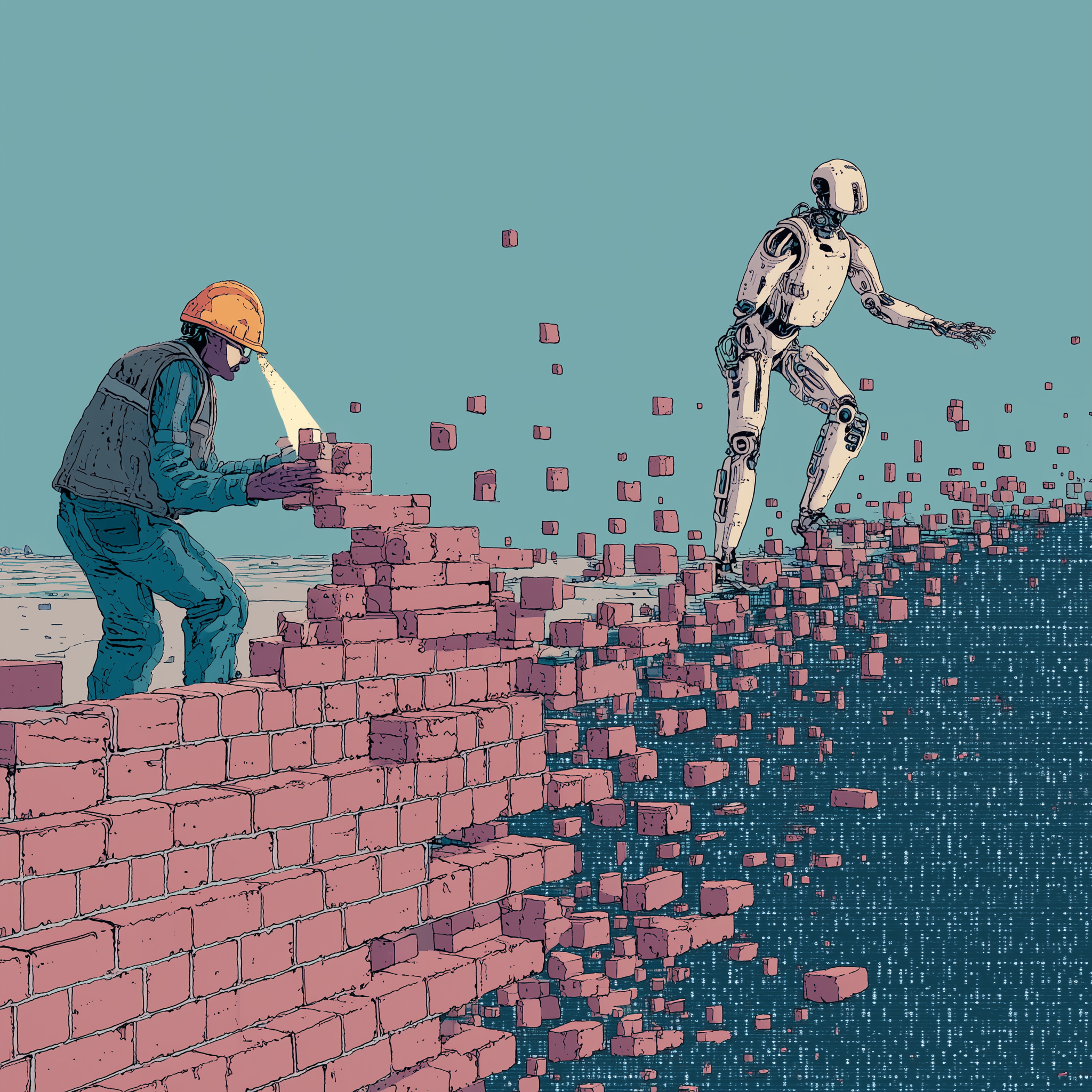
Frank Gilbreth began as a bricklayer’s apprentice and ended as one of the founders of a new science of labor. He was, by all accounts, an extraordinary observer – restless, precise, convinced that the human body in the act of skilled work contained a hidden order that could be extracted and made general. In 1911 he published Motion Study, in which he proposed that every trade harbors within its accumulated practice a reservoir of inefficiency produced by individual variation: the bricklayer’s personal arc of trowel, the typist’s idiosyncratic reach, the surgeon’s compensatory habits built up over years of operating with specific instruments in specific rooms (Gilbreth, 1911). The goal of the motion study was to render this variation legible. His instrument was the chronocyclograph: small incandescent bulbs attached to workers’ fingertips, photographed in the dark over the full duration of a task with a slow shutter speed, producing ghostly luminous traces that mapped the trajectory of the skilled hand through space and time. The body became a light source; the motion became a diagram. Gilbreth called the elementary units of motion he extracted from these traces “therbligs” – a near-reversal of his own name – and catalogued seventeen of them, from “grasp” and “transport loaded” to “position” and “release load.” Any composite task, on this view, was simply a particular combination of therbligs, and the combination could be optimized, redesigned, and ultimately written into the architecture of machines and workspaces so that the optimization no longer depended on any particular skilled worker. Harry Braverman, whose 1974 analysis of this process remains foundational, described what Gilbreth was actually doing: achieving the systematic separation of conception from execution, concentrating the knowledge required to perform a task in the management apparatus while reducing the task itself to the minimum of what an instructed body could be made to repeat (Braverman, 1974). The chronocyclograph was not merely a measuring instrument. It was a device for dispossession – for converting embodied skill into managerial property, permanently alienated from the worker whose body had generated it.
The phone strapped to Zeus’s forehead is the chronocyclograph’s contemporary heir. The footage he submits is reviewed by AI and by teams of human annotators who label the actions within it – decomposed, that is, into units functionally equivalent to therbligs. The annotation pipeline is therblig analysis by other means, updated for a training regime that requires not a protocol but a distribution. The tacit knowledge inside Zeus’s body – the way his hands grip and position, how they adapt to the geometry of his particular apartment, what compensation patterns emerge from fatigue – is being externalized, labeled, and transferred to a technical system in the transactional structure Gilbreth invented. Anson Rabinbach’s intellectual history of the “human motor” places the entire Gilbreth project within a longer genealogy: the late-nineteenth century scientific effort to understand the human body as a thermodynamic engine whose outputs could be maximized, whose wastes (fatigue, variation, hesitation) could be engineered out of the production process (Rabinbach, 1990). That science, which produced the chronocyclograph and the assembly line and the efficiency expert, is still operating – in a studio apartment in central Nigeria, at fifteen dollars an hour, for an employer Zeus is not permitted to name.
The Autor objection, at this point, operates at a different scale than the Gilbreth comparison. Autor is right that aggregate labor market outcomes across technological transitions have historically been more complex than displacement narratives suggest. The Gilbreth comparison is not a labor market argument. It is an argument about the structure of a transaction – about what is taken from a worker in a specific exchange, what that thing is worth, and who captures the surplus. At that scale, aggregate complementarity provides no comfort. Zeus’s footage generates value for Micro1 and for the robotics companies purchasing the data; Zeus receives a flat hourly fee and retains no claim over the data his body produced. This is precisely the transactional form Braverman analyzed in Taylor and Gilbreth: the worker is compensated for the time, not for the knowledge extracted from the body during that time. Decades later, the structure of the exchange has not changed. The institutional wrapper has.
That institutional wrapper is the strongest element of the counter-argument, and it deserves engagement on its own terms. Alex Rosenblat’s study of Uber’s labor regime demonstrates that gig platform work represents a genuinely novel institutional form – the complete elimination of the employment relationship, the replacement of supervisory hierarchy with algorithmic management, the systematic deployment of contractor classification to displace legal accountability from the company to the worker (Rosenblat, 2018). The chronocyclograph had an institutional home: the factory, the employer-employee relationship, the set of managerial and legal structures that, however exploitative, at least established which party was responsible to which other party for what. Micro1’s contractors inhabit no such structure. Workers interviewed by MIT Technology Review used pseudonyms because they were not authorized to discuss their own work (Kim, 2026). None of them know which robotics companies will receive their footage, on what terms, or how the data will be stored and shared. Rosenblat’s framework would insist that this opacity – the complete alienation of the data product from any institutional context the worker can access or appeal to – is precisely what distinguishes platform capitalism from industrial capitalism, and that the Gilbreth analogy makes a genuinely new problem look like a familiar one that familiar frameworks can address.
The analogy does not collapse under this pressure. What Rosenblat identifies accurately is the novel institutional container; what Braverman identified was the persistent mechanism operating inside it. The factory has dissolved into the platform. The employee has become the contractor. The supervisory hierarchy has become the algorithmic interface. And yet: tacit embodied human knowledge is still being extracted, externalized, labeled, and transferred to a technical system in a transaction the worker cannot refuse on terms other than non-participation, in which the worker retains no ongoing claim over the product of the extraction. The mechanism crosses the institutional form. The Narayanan-Kapoor skepticism about capability claims is also not a refutation of this point – it is, if anything, an intensification. If the robots never come, if the training data never generalizes as advertised, then what was extracted from Zeus’s body served no productive purpose for anyone except Micro1 and its investors. The exploitation would be complete and the return to labor would be zero. Mary Gray and Siddharth Suri’s account of ghost work identifies this as the defining feature of AI data labor: the visible, valuable outputs of AI systems are produced through invisible, underpaid labor whose contribution is systematically concealed from everyone who encounters the finished product – and whose workers have no recourse if the finished product is never finished (Gray & Suri, 2019).
The most analytically consequential feature of the present arrangement emerges when you ask what precisely Micro1 is extracting, and compare the answer to what Gilbreth was extracting. The answer is not the same, and the difference reveals something that neither the labor economics framework nor the platform sociology framework can see. Gilbreth’s motion study was organized around the elimination of variation. His chronocyclograph was a device for finding the single optimal trajectory of the hand – what he called the one best way – that, once identified, could be standardized and taught to any worker, or inscribed in a machine. The worker’s personal adaptations were inefficiency; the standard was the destination. Micro1’s CEO Ali Ansari is explicit that the operation runs on a precisely opposite premise: the robot needs, he explains, “lots and lots of variations” in order to generalize well for basic navigation and manipulation of the world (Kim, 2026). The humanoid robot requires not the optimal path but the full distribution of human paths – the bored repetition of someone who finds ironing tedious, the cramped workaround of someone cooking in a kitchen too small for the recipe, the particular hesitation of hands uncertain which drawer holds the spatula. Zeus’s boredom, his fatigue, his adaptation to the specific constraints of his studio apartment, are not inefficiency to be designed out of the system. They are the product. The human body’s resistance to standardization – the irreducible personal variation that Gilbreth spent his career trying to eliminate – is now the economic value.
This inversion opens directly onto the final and most arresting dimension of the present case, the one that the project of historical comparison reaches only when it is extended beyond what the industrial analogy alone can supply. Yampolskiy’s account of AI’s fundamental properties argues systematically that as AI systems become more capable, they become less explainable, less predictable, and less controllable – not as an engineering failure to be corrected but as a structural consequence of the kind of learning these systems perform (Yampolskiy, 2024). A system trained on the full distribution of human variation in domestic manipulation tasks will internalize patterns that no individual human movement can account for and that no annotator can fully trace. The workers are not building a machine that will do what they do. They are building a machine that will generalize from everything they do into a behavioral space that exceeds any particular human performance, in ways that will eventually become opaque to the engineers who built it. Shoshana Zuboff’s concept of behavioral surplus is relevant here: the extraction of behavioral data as raw material for prediction and control (Zuboff, 2019). But the Micro1 pipeline exceeds her framework in a specific way. The behavioral surplus Zuboff analyzes is extracted from populations performing their ordinary lives, then used to model those same lives for commercial purposes. What Micro1 extracts is being used to build an agent that will eventually act in the world with a degree of autonomy no one can fully predict. Zeus’s tacit knowledge is not being fed back to predict Zeus’s future behavior. It is being used to construct a non-human system whose future behavior will be determined by everything Zeus contributed, combined with everything contributed by thousands of other workers across fifty countries – and then made general in ways that will answer to no single human intention.
What remains, then, after the analogy has done its work, is a hierarchy of explanatory reach. Autor is correct that aggregate labor market effects of automation are historically complex and that displacement narratives routinely undercount complementarity. Narayanan and Kapoor are correct that specific capability claims about humanoid robots may prove to be AI snake oil – that the generalization problem is unsolved, and that the footage Zeus generates may never train a robot that can perform what Zeus performs. Rosenblat is correct that platform labor represents a genuinely novel institutional form whose legal architecture the Gilbreth analogy could obscure if applied without care. All three corrections are necessary and none is sufficient. The Gilbreth comparison remains analytically stronger because it identifies the precise mechanism of conversion – tacit embodied knowledge into external legible data, producing permanent alienation of the worker from the intelligence her body generated – that persists across the institutional shift from factory to platform, from national workforce to global precariat, from efficiency as target to variation as product. And it points toward what is genuinely new in the present case in a way that no other framework can: the workers are not simply training machines to replace them. They are contributing to the construction of something that will eventually exceed the comprehension of everyone who built it. The domestic interior has been enclosed. The home has been absorbed into the extractive apparatus of labor rationalization.
The global wage differential has made that enclosure affordable at a scale no Taylorist administrator could have imagined. And the product of the extraction is not a standard – it is a system that will answer to no standard, that will act in ways no particular human motion can explain, that will be, as Yampolskiy argues with considerable rigor, unexplainable and uncontrollable in its mature form. Zeus raises his arms like a sleepwalker in his studio apartment in central Nigeria, and his hands trace a path through the air above a mattress. The path becomes a dataset. The dataset becomes a training run. The training run becomes something that no one, including the engineers who ran it, can fully account for. He is not building his replacement. He is building something stranger than that: a machine that will eventually know how to make a bed better than Zeus knows, without knowing that it knows, without the knowledge being anyone’s to claim.
References
Autor, D. H. (2015). Why are there still so many jobs? The history and future of workplace automation. Journal of Economic Perspectives, 29(3), 3-30. https://doi.org/10.1257/jep.29.3.3
Braverman, H. (1974). Labor and monopoly capital: The degradation of work in the twentieth century. Monthly Review Press. Publisher page | Internet Archive | JSTOR
Gilbreth, F. B. (1911). Motion study: A method for increasing the efficiency of the workman. D. Van Nostrand. Internet Archive (full text) | Open Library
Gray, M. L., & Suri, S. (2019). Ghost work: How to stop Silicon Valley from building a new global underclass. Houghton Mifflin Harcourt. Author site | Amazon
Kim, M. (2026, April 1). The gig workers who are training humanoid robots at home. MIT Technology Review. https://www.technologyreview.com/2026/04/01/1134863/humanoid-data-training-gig-economy-2026-breakthrough-technology/
Narayanan, A., & Kapoor, S. (2024). AI snake oil: What artificial intelligence can do, what it can’t, and how to tell the difference. Princeton University Press. Publisher page | Amazon
Rabinbach, A. (1990). The human motor: Energy, fatigue, and the origins of modernity. Basic Books. Amazon | Internet Archive
Rosenblat, A. (2018). Uberland: How algorithms are rewriting the rules of work. University of California Press. Publisher page | Amazon
Voss, D. (2026, April 2). Gig workers in 50+ countries are filming themselves doing chores to train humanoid robots for $15 an hour. Silicon Canals. https://siliconcanals.com/sc-a-gig-workers-in-50-countries-are-filming-themselves-doing-chores-to-train-humanoid-robots-for-15-an-hour/
Yampolskiy, R. V. (2024). AI: Unexplainable, unpredictable, uncontrollable. CRC Press/Chapman & Hall. Publisher page | Amazon
Zuboff, S. (2019). The age of surveillance capitalism: The fight for a human future at the new frontier of power. PublicAffairs. Publisher page | Amazon
Leave a Reply